☰ Cards, readings & spreads
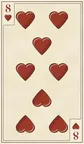
Eight of Hearts meaning in cartomancy
8♥︎ · 8 of Hearts · Hearts · emotional fulfillment · lasting affection · emotional maturity · support · self-love
How it is read
In cartomancy, this card is read as emotional fulfillment, lasting affection, and the maturity needed to handle close relationships well. Readers take the Eight of Hearts as a way to examine how care works in practice: who listens after a difficult day, who follows through on an offer of help, and who makes room for an honest answer. A friend’s thoughtful advice or a family conversation that finally addresses an awkward subject fits this reading. The emphasis is on affection expressed through attention and responsibility, rather than declarations alone.
Traditions differ in their emphasis: some readers take it as a loved one or protector, while others focus on deep love and emotional understanding. In a spread about a particular person, the protective reading can describe someone who helps with a move or checks in during a demanding week. In a position concerning the questioner’s approach, readers take it as a prompt to examine emotional judgment, especially when closeness and personal boundaries pull in different directions. The useful question is whether support leaves both people free to speak, or whether keeping everyone comfortable has become more important than addressing what needs to change.
Reading this card for a question of your own? New customers get 5 minutes with a live reader for $1 →
In love
In a relationship reading, the Eight of Hearts is read as deep affection, emotional maturity, and the wish to build a lasting bond. Readers might apply that to partners making time for a conversation they keep postponing, or to someone asking for consistency instead of another romantic declaration. Some readers emphasize commitment, while others emphasize knowing your own needs well enough to recognize when a relationship no longer fits them. For an existing couple or a new connection, the practical focus is the same: how openly can each person ask for care, disagree, and maintain a separate life?
Money and work
For money and work, readers take this card as a prompt to examine support and emotional judgment among the people involved in a decision. A job offer may raise questions about a manager’s manner, the team’s willingness to share credit, or the personal value of the work alongside its pay. When a bill or family loan is the issue, readers take it as a prompt to separate freely offered help from help that carries an unspoken obligation. In a career spread, readers apply its association with emotional maturity to mentoring or handling a difficult client: care for the person while keeping the terms clear.
Yes or no?
Yes · by the color rule (red for yes, black for no): yes
Read from its themes of affection and emotional fulfillment, the Eight of Hearts leans yes, particularly for a question about opening a conversation or accepting support. That agrees with the simple color rule in which red answers yes and black answers no. Some readers instead treat it as a request to consult your own emotional judgment, so the method matters when assigning the answer.
Prefer to ask with tarot? Pull a yes or no card here.
As a birth card
The persuasive organizer among friends is a familiar role for people with this birth card, whose warmth can slide into expecting agreement. Cardology readers describe a sharp mind, personal charm, and a talent for teaching, alongside high standards that can become difficult for anyone to satisfy. In everyday life, that might look like patiently explaining a difficult idea to a coworker, then struggling to accept that the coworker prefers another approach. Among friends, enthusiasm for a shared plan can turn into making others feel guilty for declining. Readers differ in emphasis: some focus on using personal influence responsibly, while others read the pattern as a mirror of self-love, asking how much self-approval depends on other people's responses.
Birthdays with this card
- August 31
- September 29
- October 27
- November 25
- December 23
In cardology the card comes from the month and day alone: 55 − (2 × month + day) gives the solar value, and 8 is the Eight of Hearts. What playing card are you? Find yours →
Tarot counterpart
Readers who use both decks pair Hearts with Cups, Clubs with Wands, Diamonds with Pentacles and Spades with Swords, the pairing the French occultist Papus already gave. Ace to Ten keep their numbers. On that pairing the Eight of Hearts sits where the Eight of Cups does. The two decks are read in separate traditions, so the meanings overlap in places and part ways in others.
 The tarot counterpart: Eight of Cups →Hearts pair with Cups. Its upright and reversed meaning, love and yes or no.
Questions
What is the Eight of Hearts read as for someone's feelings?
Readers take it as affection with an interest in emotional closeness, often accompanied by a desire to feel understood. One reading emphasizes settled attachment; another emphasizes the person’s growing clarity about what they need. In practice, the question becomes how those feelings are expressed through listening, making time, and discussing difficult subjects.
Can the Eight of Hearts represent a person?
Yes. Readers who use its protective interpretation may identify a trusted ally rather than a romantic partner: a sibling who helps handle a family disagreement, for example. A position assigned to a person supports that approach; a position assigned to advice puts the emphasis on how to offer or receive support.
Why is the Eight of Hearts associated with emotional power?
In cardology, readers connect this card with influence in close relationships and the responsibility that comes with it. Readers differ over whether leadership in love or self-love deserves greater emphasis. A useful everyday example is the difference between encouraging a partner and making affection conditional on getting your way.
How do you read the Eight of Hearts with other cards?
Start with the reading system and the position it occupies in the spread. In a position assigned to help, readers may take it as emotional support; in a position assigned to difficulty, they may examine demanding expectations around closeness. Read the surrounding cards within the same tradition rather than switching systems to obtain a preferred answer.