☰ Cards, readings & spreads

Tarot combination calculator
Pick two cards from the full 78-card deck, upright or reversed, and read them as one pair. Code works out the elemental dignity, the numbers, the balance of Major and Minor Arcana and a joint yes or no, and shows every step so you can check it.
Choose two cards
No card by that name. Try one word: star, tower, cups, knight.
Example: the most searched pair. Pick your own cards above.
Example pair
The Sun and The Moon
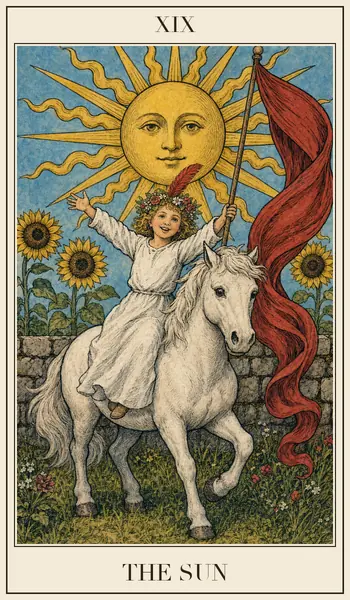
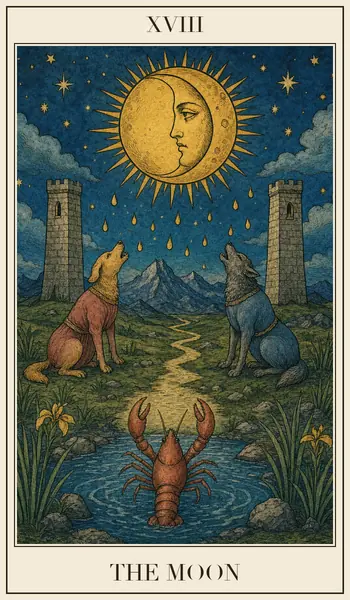
Fire + Water · contrary elements · Mixed: the cards disagree
- Elements
- Fire + Water · contrary elements
- Pair strength
- Weak
- Yes or no
- Mixed: the cards disagree
- Arcana
- Two Major Arcana
How the pair reads
The Sun brings clarity and success; The Moon brings illusion and anxiety. Fire and Water are contrary elements. In the Golden Dawn method they weaken each other: both cards lose force, and the pair tends to describe a tension that has not settled.
Two Major Arcana: the pair describes a large theme or a turning point rather than a passing situation, and much of it sits outside your direct control.
The Moon (XVIII) and The Sun (XIX) stand next to each other in the Major Arcana: read them as one step following the other.
One card reads yes and the other no. A split like this usually points to a question with two parts; ask them one at a time.
The Sun is Fire (the Sun, ruler of Leo); The Moon is Water (Pisces, a Water sign).
A reader’s note on this pair
You receive positive feedback, then keep rereading it for a criticism you might have missed. With The Sun and The Moon upright, the pair is read as recognizing that something went well while searching for a reason not to trust it. Fire and Water weaken each other here: praise does not stop the checking, and the checking makes it harder to accept the praise. Ask yourself whether you are investigating a specific gap in the feedback or looking for reassurance that another reading cannot supply.
The Sun
clarity · success · vitality
The Sun is the least ambiguous card in the deck.
Full meaning of The Sun →The Moon
illusion · anxiety · the unclear
The Moon lights a path badly — everything is visible but nothing is certain.
Full meaning of The Moon →Ask a yes or no question → Draw random cards →
Reading this pair for a real question? Ask a live reader about it → Affiliate link.
Popular tarot card combinations
The pairs people search for most, by search data for the US. Each link opens the pair in the calculator, with a reader’s note on top of the worked reading.
- The Sun and The MoonContrary elements Fire + Water
- King of Swords and Queen of SwordsSame element Air + Air
- King of Pentacles and Queen of PentaclesSame element Earth + Earth
- King of Wands and Queen of WandsSame element Fire + Fire
- King of Cups and Queen of CupsSame element Water + Water
- Four of Pentacles and JudgementNeutral elements Earth + Fire
- Justice and JudgementFriendly elements Air + Fire
- Ace of Wands and Knight of PentaclesNeutral elements Fire + Earth
- Justice and DeathNeutral elements Air + Water
- Six of Cups and The StarNeutral elements Water + Air
- Ace of Cups and The WorldFriendly elements Water + Earth
- Ace of Pentacles and Ace of WandsNeutral elements Earth + Fire
- The Moon and The StarNeutral elements Water + Air
- Ace of Swords and Ace of CupsNeutral elements Air + Water
- Ace of Cups and Knight of CupsSame element Water + Water
- Queen of Cups and Queen of SwordsNeutral elements Water + Air
- King of Cups and Knight of CupsSame element Water + Water
- Page of Cups and Knight of CupsSame element Water + Water
- Ace of Swords and Ace of WandsFriendly elements Air + Fire
- Death and The TowerContrary elements Water + Fire
- The Star and StrengthFriendly elements Air + Fire
- King of Cups and King of PentaclesFriendly elements Water + Earth
- Knight of Cups and Knight of SwordsNeutral elements Water + Air
- The Hierophant and The FoolContrary elements Earth + Air
- Page of Pentacles and Nine of WandsNeutral elements Earth + Fire
- Page of Wands and Page of PentaclesNeutral elements Fire + Earth
- Knight of Cups and Queen of CupsSame element Water + Water
- Queen of Wands and Queen of SwordsFriendly elements Fire + Air
- Death and Queen of CupsSame element Water + Water
- Wheel of Fortune and Ace of PentaclesNeutral elements Fire + Earth
- Knight of Wands and Knight of SwordsFriendly elements Fire + Air
- Death and Ace of PentaclesFriendly elements Water + Earth
- Justice and Ace of CupsNeutral elements Air + Water
- Ace of Cups and Ace of PentaclesFriendly elements Water + Earth
- Ace of Cups and JudgementContrary elements Water + Fire
- Two of Wands and Three of WandsSame element Fire + Fire
- Knight of Cups and The TowerContrary elements Water + Fire
- Queen of Wands and Queen of PentaclesNeutral elements Fire + Earth
- Death and The DevilFriendly elements Water + Earth
- Ace of Swords and Ace of PentaclesContrary elements Air + Earth
- Justice and StrengthFriendly elements Air + Fire
- Strength and DeathContrary elements Fire + Water
- The Moon and Page of CupsSame element Water + Water
- Two of Wands and Two of SwordsFriendly elements Fire + Air
- Knight of Pentacles and Queen of PentaclesSame element Earth + Earth
- The Moon and Queen of PentaclesFriendly elements Water + Earth
- Death and Knight of PentaclesFriendly elements Water + Earth
- The Star and The WorldContrary elements Air + Earth
- Knight of Cups and The DevilFriendly elements Water + Earth
- The Devil and Page of CupsFriendly elements Earth + Water
- Eight of Cups and Ace of CupsSame element Water + Water
- Knight of Swords and StrengthFriendly elements Air + Fire
- Queen of Swords and The SunFriendly elements Air + Fire
- Ace of Pentacles and The SunNeutral elements Earth + Fire
- The Fool and Page of CupsNeutral elements Air + Water
- Death and Ten of CupsSame element Water + Water
- Queen of Wands and Ace of WandsSame element Fire + Fire
- Queen of Pentacles and Knight of SwordsContrary elements Earth + Air
- Page of Pentacles and Ace of PentaclesSame element Earth + Earth
How to read two tarot cards together
You read a pair as one sentence, not as two separate interpretations placed side by side. Each card brings its keywords, but the combined reading connects them. The calculator follows this sequence: keywords; how the elements interact, called elemental dignities; the Major Arcana and Minor Arcana mix; repeated numbers or ranks and consecutive cards; which card is reversed; and a combined yes or no.
With two Major Arcana, the pair is read as a large theme or a turning point. With one Major and one Minor, the Major sets the theme while the Minor shows where it lands day to day. Two Minor Arcana are read as an everyday situation, mostly one you can steer. Two court cards are often read as two people, or two sides of how you are handling something.
For example, the Three of Cups followed by the Four of Cups is read as one everyday stage leading into the next: both are Minor Arcana, consecutive within one suit. You connect the stages in a sentence rather than treating each as a separate subject. A repeated number, such as two Threes, instead doubles that number’s theme. For the combined yes or no, an upright yes card reversed is read as no; an upright no card reversed is read as unclear; and two cards that disagree give you a mixed answer.
Elemental dignities: which cards help each other and which cancel out
When you compare two cards by elemental dignity, you are assessing how strongly each is read, not whether the pairing is good or bad. The rule comes from Book T, written by MacGregor Mathers for the Hermetic Order of the Golden Dawn, where a card is judged by the two cards on either side; for a two-card reading, readers apply the rule to the pair. The qualities are Fire, hot and dry; Air, hot and moist; Water, cold and moist; and Earth, cold and dry. Wands correspond to Fire, Cups to Water, Swords to Air, and Pentacles to Earth.
Cards of the same element strengthen each other greatly, for better or worse: a strengthened difficult card is read as more difficult. Friendly pairings support each other through shared heat or cold, while contrary elements greatly weaken each other and cancel each other’s force. The disagreement concerns Fire with Earth and Air with Water, which share dryness or moisture: Mary K. Greer calls them somewhat friendly, Joy Vernon calls them neutral, and Tony Louis, following Book T, calls them plainly friendly and regards neutrality as a modern simplification. This calculator shows those pairings as neutral, mildly friendly, so you can distinguish them from both stronger support and opposition.
| Element | Fire | Air | Water | Earth |
|---|---|---|---|---|
| Fire | strengthen | support | weaken | mildly friendly |
| Air | support | strengthen | mildly friendly | weaken |
| Water | weaken | mildly friendly | strengthen | support |
| Earth | mildly friendly | weaken | support | strengthen |
- Same element
- Greatly strengthen, for better or worse
- Friendly elements
- Support each other
- Neutral elements
- Mildly friendly; little effect
- Contrary elements
- Greatly weaken each other
Rule sources: Book T of the Golden Dawn as read by Mary K. Greer, Joy Vernon and Tony Louis. Fire with Earth and Air with Water are the disputed pair: neutral for Greer and Vernon, friendly for Louis. The calculator shows them as neutral.
Where the Major Arcana get their element
In the Golden Dawn system, every Major Arcana card is attributed to a zodiac sign, a planet, or an element. A sign card takes its sign’s element: The Emperor (Aries) is read as Fire, The Star (Aquarius) as Air, Death (Scorpio) as Water, and The Devil (Capricorn) as Earth. Three cards have direct elemental attributions: The Fool is Air, The Hanged Man is Water, and Judgement is Fire.
Planet cards have no element of their own; this calculator follows Joy Vernon’s table, using the element of a sign each planet rules. You get Fire for The Sun, The Tower, and Wheel of Fortune; Water for The High Priestess; Air for The Magician; and Earth for The Empress and The World. Readers differ on these assignments, so you should treat planetary elements as the softest part of the reading, while the Minor Arcana take the element of their suit.
| Element | Suit | Major Arcana |
|---|---|---|
| Fire | Wands | The Emperor, Strength, Wheel of Fortune, Temperance, The Tower, The Sun, Judgement |
| Air | Swords | The Fool, The Magician, The Lovers, Justice, The Star |
| Water | Cups | The High Priestess, The Chariot, The Hanged Man, Death, The Moon |
| Earth | Pentacles | The Empress, The Hierophant, The Hermit, The Devil, The World |
Questions
What is a tarot combination calculator?
A tarot combination calculator is a page tool where you pick two cards and set each as upright or reversed. Its code reads the pair using these factors: Golden Dawn elemental dignities; Major or Minor Arcana; repeated numbers; reversals; and a combined yes or no. There are 3,003 possible pairs of 78 cards. The result is read as a starting point for your own reading, not a forecast.
Which tarot cards go well together?
When you compare cards by elemental dignities, cards of the same element strengthen each other, while Fire with Air and Water with Earth are friendly, supportive pairings. A strengthening combination is read as greater emphasis, not necessarily good news. If you pair two difficult cards of the same element, their shared element makes the difficulty louder rather than softening it.
What does it mean when two tarot cards cancel each other out?
When two tarot cards cancel each other out, the pair is read as an unsettled tension that gives you a soft answer. In the Golden Dawn method, contrary elements, Fire with Water and Air with Earth, weaken each other greatly. Both cards lose force, so you read the tension between them rather than treating either card as a firm answer.
Do reversed cards change a combination?
Yes, a reversed card changes how you read a combination: it is read as blocked, delayed, or turned inward. With one card reversed, the upright card shows you what is available, while the reversed card shows what is stuck. With both reversed, the pair is read as what is not moving yet. For yes or no, an upright yes reversed is read as no; an upright no reversed is read as unclear.
Does the order of the two cards matter?
No—for elemental dignities and the yes or no answer, you get the same result in either order. In a spread with named positions, however, position changes what each card is asked about. A card in the past position is read as answering a different question than one in the future position; the same distinction applies to you and them. The calculator does not know your positions.