☰ Cards, readings & spreads

The Major Arcana: all 22 tarot card meanings in order
Drawing a Major Arcana card does not make a situation more fated or automatically more important. In a reading, this part of the deck is read as a framework for examining choices, roles, and recurring patterns rather than a forecast of exceptional events. Use the ordered cards below as a reference: each upright opening sentence introduces an interpretation, while the verdict gives this site's shorthand for a yes-or-no question.
The sequence, card by card
0Set apart
- 0
 The FoolYes
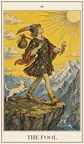
The Fool is the moment before the decision — standing at the edge with everything you own in one small bag.
I–VIIRow of seven
Here, the opening stretch is read as an exploration of agency and social roles. The Magician brings attention to capability. The Emperor adds the question of how you establish structure.
- I
 The MagicianYes
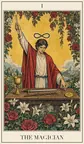
The Magician has everything laid out on the table — all four suits, every tool.
- II
 The High PriestessUnclear
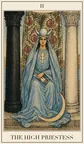
The High Priestess sits between two pillars with a scroll half-hidden.
- III
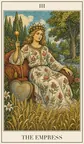 The EmpressYes
The Empress is growth you can see — a project bearing fruit, a body being cared for, a relationship with warmth in it.
- IV
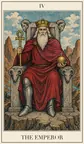 The EmperorYes
The Emperor builds the frame that lets things last. Rules, boundaries, discipline — unglamorous and load-bearing.
- V
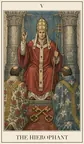 The HierophantUnclear
The Hierophant is the established way of doing things — institutions, mentors, the accumulated method.
- VI
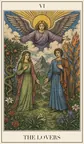 The LoversYes
Despite the name, The Lovers is primarily a card about choice — and specifically a choice that reveals what you actually value.
- VII
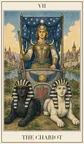 The ChariotYes
The Chariot is forward motion achieved by holding opposing forces in balance — the two sphinxes pull different ways and the driver goes anyway.
VIII–XIVRow of seven
Across the middle stretch, experience is read as something to examine rather than simply pursue. The Hermit introduces reflection. Temperance brings that examination toward adjustment and integration.
- VIII
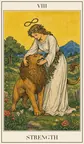 StrengthYes
Strength shows a woman closing a lion's jaw with her hands, calmly.
- IX
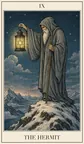 The HermitNo
The Hermit steps away from the crowd with a single lamp. Deliberate solitude for the purpose of seeing clearly.
- X
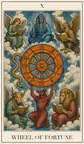 Wheel of FortuneYes
The Wheel marks a change in circumstance driven by something larger than your effort.
- XI
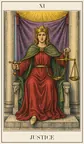 JusticeUnclear
Justice weighs what actually happened, not what was intended.
- XII
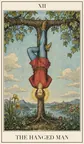 The Hanged ManNo
The Hanged Man hangs willingly and appears at peace. The card describes a pause you cannot shorten and a viewpoint you can only reach by staying in it.
- XIII
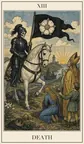 DeathNo
Death almost never means literal death. It marks a definite ending that makes room — a chapter genuinely closing, not fading.
- XIV
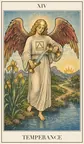 TemperanceYes
Temperance mixes two things into something neither could be alone.
XV–XXIRow of seven
Toward the end, the sequence is read as a reconsideration of constraints and completion. The Devil invites questions about attachment. The World offers a frame for considering the whole.
- XV
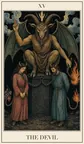 The DevilNo
The figures on this card wear chains they could lift off. The Devil is bondage you participate in — habits, dependencies, relationships that cost more than they give and continue anyway.
- XVI
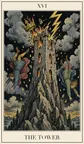 The TowerNo
The Tower falls because it was built wrong, and lightning simply finds the flaw.
- XVII
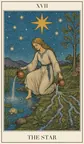 The StarYes
The Star follows The Tower, and that order matters — this is the calm after something broke.
- XVIII
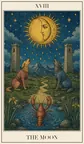 The MoonNo
The Moon lights a path badly — everything is visible but nothing is certain.
- XIX
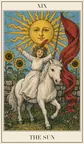 The SunYes
The Sun is the least ambiguous card in the deck. Clarity, warmth, things visibly working.
- XX
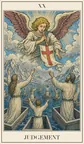 JudgementYes
Judgement is the moment of honest review — looking at what you have done and deciding what it means.
- XXI
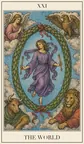 The WorldYes
The World closes the cycle. Completion that feels earned — a project finished, a journey arriving, integration of everything the previous cards demanded.
Upright and reversed keywords for all 22 side by side: the full card list.
How the 22 are numbered
This site follows the Rider–Waite–Smith sequence: The Fool carries 0, followed by I The Magician through XXI The World. The Fool stands apart in the layout because the remaining 21 cards form a common teaching arrangement of three rows of seven. Those rows run I–VII, VIII–XIV, and XV–XXI. Keeping zero separate lets you examine the numbered sequence in manageable groups without leaving any card out.
Deck traditions differ at VIII and XI: in the Tarot de Marseille, Justice is VIII and Strength is XI. A. E. Waite swapped their positions in the Rider–Waite–Smith deck, placing Strength at VIII and Justice at XI. This site uses that Rider–Waite–Smith numbering throughout, so check the card's name as well as its numeral when comparing this sequence with another deck.
| Card | Rider–Waite–Smith (this site) | Tarot de Marseille |
|---|---|---|
| Strength | VIII | XI |
| Justice | XI | VIII |
Major Arcana and the four elements
Golden Dawn attributions connect zodiac-associated cards to the elements also used for the suits: Fire to Wands, Water to Cups, Air to Swords, and Earth to Pentacles. For example, The Emperor corresponds to Aries, a Fire sign, while Death corresponds to Scorpio, a Water sign. The table distinguishes these zodiac connections from direct elemental attributions and planetary attributions. Planetary cards have no single element in this grouping, so the suit links offer a comparison between systems, not a claim that each Major Arcana card belongs to a suit.
Fire → Wands
- The EmperorAries
- StrengthLeo
- TemperanceSagittarius
- Judgementelemental
Water → Cups
- The ChariotCancer
- The Hanged Manelemental
- DeathScorpio
- The MoonPisces
Air → Swords
- The Foolelemental
- The LoversGemini
- JusticeLibra
- The StarAquarius
Earth → Pentacles
- The HierophantTaurus
- The HermitVirgo
- The DevilCapricorn
Planets · no single element
- The MagicianMercury
- The High PriestessMoon
- The EmpressVenus
- Wheel of FortuneJupiter
- The TowerMars
- The SunSun
- The WorldSaturn
Golden Dawn attributions, each checked against at least two independent sources, including tarotelements.com, angelorum.co, pagangrimoire.com, the-crone.com.
Which Major Arcana read as yes
Yes 13
Verdicts are for upright cards. Drawn reversed, a yes reads as no and a no softens to unclear. Draw one card for your question →
When a reading is full of Major Arcana
A spread heavy with Major Arcana is read as an invitation to examine the assumptions organizing your question: what you consider acceptable, what authority you recognize, or what you keep returning to. Start with each card's position in the spread rather than treating the group as a single dramatic message. Then look for agreement or friction between the interpretations, including any Minor Arcana present. Turn that comparison into a practical question you can investigate, rather than an outcome you expect the cards to deliver.
Questions about the Major Arcana
How many Major Arcana cards are there?
There are 22 Major Arcana cards in a 78-card tarot deck; the other 56 are Minor Arcana. The Fool is included in that total even when displayed separately. This site's Major Arcana verdicts total 13 yes, 6 no, and 3 unclear, but those labels are editorial reading categories, not probabilities of an event occurring.
Why is The Fool numbered 0?
Zero can be understood as the position before the numbered sequence begins, rather than a missing place within it. In the Fool's journey approach, The Fool is read as the traveler who encounters the other 21 cards in turn. That gives you a way to connect the images as a learning sequence; it is an interpretive framework, not a historical explanation for the numbering.
Why are Strength and Justice numbered differently in some decks?
The difference comes from the deck's ordering convention: Tarot de Marseille places Justice at VIII and Strength at XI. A. E. Waite exchanged those positions in the Rider–Waite–Smith deck, which this site follows. If a guide and your deck disagree, match the interpretation to the card's name rather than assuming the same numeral identifies the same card.
What does it mean when you draw a lot of Major Arcana?
Drawing many of these cards is read as a reason to narrow your focus, not to raise the stakes. Choose the card whose interpretation most clearly relates to your question and describe that connection in ordinary language. If the connection remains vague, revisit the question or the spread positions; the number of Major Arcana alone does not establish urgency or predict an outcome.
The rest of the deck
Fifty-six suit cards carry the everyday detail the Major Arcana leave out.
Read them in a spread
Where a card lands changes what it is asked to answer.