☰ Cards, readings & spreads
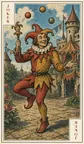
The Joker in cartomancy
The extra card · outside the four suits · unknown factors · originality · independence · impulsiveness · hidden motives
How it is read
No suit sign places this extra card among hearts, diamonds, clubs, or spades; its illustration varies between decks. In cartomancy, the Joker is read as an unknown factor, an unconventional approach, or behavior that slips outside the usual rules. Readers differ over its place in a spread: many leave it out, some use it to represent the person asking, and others read it as uncertainty, originality, or poorly considered action. Its position helps distinguish a useful departure from routine, such as considering an unfamiliar job, from acting before checking the pay, hours, and responsibilities.
When the Joker represents the person asking, readers give particular attention to the surrounding cards as the concerns closest to that person. When it has its own interpretation, readers take it as a reason to examine what remains unsettled: a move without a firm address, a conversation repeatedly postponed, or advice whose purpose is unclear. Some traditions emphasize freedom and fresh starts; others emphasize immaturity, secrecy, or appearances that invite closer questioning. The practical question is whether the situation needs room for experimentation or clearer terms before anyone commits.
Reading this card for a question of your own? New customers get 5 minutes with a live reader for $1 →
In love
In a relationship reading, the Joker is read as spontaneity, independence, or uncertainty about what each person wants. Readers may connect it with a relationship that resists familiar labels, playful conversation that avoids a serious subject, or someone changing plans whenever commitment comes up. Surrounding cards help shift the emphasis between enjoying space together and using that space to dodge a conversation about exclusivity, shared expenses, or a move. Where a tradition emphasizes hidden motives, the useful question is what each person has actually said about the relationship and what has been left to assumption.
Money and work
In questions about money and work, the Joker is read as an unconventional opportunity, an unsettled arrangement, or an impulsive decision. A freelance offer with vague duties, a friend's business suggestion, or a bill left out of the monthly budget gives this reading a concrete setting. Readers who emphasize originality may explore a different way of earning or solving a workplace problem; those who emphasize folly look at skipped checks and loosely defined agreements. The useful distinction is between trying something on manageable terms and committing money or time before the price, deadline, and responsibilities are clear.
Yes or no?
Unclear — depends · no suit and no color, so the color rule does not apply
The Joker is read as maybe: an unknown factor or unsettled condition keeps the question open. It has no color and no suit, so the red-yes / black-no rule does not apply. For a question such as whether to accept a job offer, readers take it as a prompt to identify the missing terms, especially pay, hours, or duties.
Prefer to ask with tarot? Pull a yes or no card here.
As a birth card
Outside the usual suit and rank structure, the Joker is read as a versatile, creative personality that resists a fixed role. Independence and a youthful approach feature in accounts of this birth card, with an ease in trying on different roles rather than settling into a familiar identity. At a gathering, this might show in playful impersonations that get everyone laughing; in a group activity, it might show in inventing an approach nobody else considered. That flexibility becomes troublesome when changing character to suit the company makes it hard to express a personal preference or take something seriously. Sources disagree about how firmly to define this personality: some present a recognizable life pattern, while others regard the Joker’s absence from their standard spreads as a limit on interpretation.
Birthdays with this card
- December 31
In cardology the card comes from the month and day alone: 55 − (2 × month + day) gives the solar value, and December 31 is the only date that comes out at 0. What playing card are you? Find yours →
Tarot counterpart
Readers most often compare the Joker with the Fool, the unnumbered card of the tarot. The comparison is a habit of readers who use both decks; the reading above comes from playing-card cartomancy, so take the two separately.
 The tarot counterpart: The Fool →The unnumbered card of the tarot: its upright and reversed meaning, love and yes or no.
Questions
Should I leave the Joker in a cartomancy deck?
That depends on the method you use. Many readers remove it, while others assign it a specific role before shuffling. Choose whether it represents the person asking or carries an interpretation of its own, then keep that choice consistent throughout the spread.
How do you read both Jokers in cartomancy?
Some readers assign the Jokers contrasting roles, such as action and receptivity, or attention and emotion. Other methods use only a single Joker or exclude them altogether. Set those roles before dealing so that each has a clear function rather than changing its interpretation to suit the answer.
Is the Joker read as good or bad in cartomancy?
Readers take it as neither favorable nor unfavorable by default. An unconventional approach can be useful when a familiar routine has stalled; the same disregard for convention can be read as carelessness when an agreement needs precision. Read the spread position and neighboring cards together before choosing the emphasis.