☰ Cards, readings & spreads
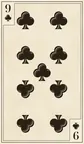
Nine of Clubs meaning in cartomancy
9♣︎ · 9 of Clubs · Clubs · distance · persistence · achievement · completion · knowledge
How it is read
Reading every black card as trouble misses the distinction here: in cartomancy, the Nine of Clubs is read as persistence, achievement, and distance, with the emphasis changing between traditions. French cartomancy readers associate it with gifts and material success, while Italian readings emphasize separation in time or place; these are different conventions, not a single agreed interpretation. For a practical reading, the common ground is effort measured against what remains unfinished: an application awaiting a reply, a qualification nearly completed, or a move requiring more preparation. Readers take it as a reason to examine the remaining work rather than assume that effort already spent settles the outcome.
In a spread, the question and surrounding cards help distinguish a worthwhile commitment from a process that has simply become drawn out. Beside themes of communication, readers may emphasize a postponed conversation or advice arriving from someone far away; in a work question, they may emphasize sustained effort and recognition. Gift-centered readings instead focus on support received, such as practical help or a useful introduction. The useful question is specific: what still needs doing, and what are you merely waiting for?
Reading this card for a question of your own? New customers get 5 minutes with a live reader for $1 →
In love
In a relationship spread, the Nine of Clubs is read as distance, patience, or the effort involved in maintaining a connection. That distance may be literal, as when partners live in different cities, or practical, as when work schedules keep pushing a serious conversation into next week. Some readers take it as affection held back by caution, but the surrounding cards and the relationship question determine whether that interpretation fits better than simple separation. A useful reading asks who is making time, which conversation keeps being postponed, and whether both people are contributing to the relationship rather than leaving one person to carry it.
Money and work
For money and work, the Nine of Clubs is read as sustained effort, recognition, or the distance between a plan and its completion. In achievement-centered traditions, readers connect it with a demanding qualification, a long-term business agreement, or work ready for review; gift-centered traditions also associate it with financial help or an inheritance. Distance-centered readings put the emphasis elsewhere: a job offer still being discussed, an invoice awaiting payment, or a project stretched across several locations. The practical focus is on separating resources already available from those still under discussion, then checking the paperwork, remaining tasks, and cost of continuing.
Yes or no?
No · by the color rule (red for yes, black for no): no
Under the red-yes, black-no rule, the Nine of Clubs is read as no. A distance-centered interpretation agrees when the question concerns immediate readiness or completion: there is still a gap to address. Achievement-centered readers sometimes choose a conditional yes instead, so the traditions differ; this entry keeps the no verdict rather than treating persistence as an assured result.
Prefer to ask with tarot? Pull a yes or no card here.
As a birth card
A taste for risk can make this birth card sound reckless, but readers describe curiosity and creative thinking behind the appetite for new experiences. Sources disagree over the central emphasis: some frame that intelligence as knowledge shared in service to others, while others foreground adventure or the desire for recognition. The strength is an eagerness to learn and see possibilities, whether that involves exploring an unfamiliar subject or finding a clearer way to explain something to a friend. That same curiosity can trip people up when an interesting experiment becomes a risk taken without much thought, or pleasure crowds out responsibilities. Readers also describe the harder work of letting go of old ideas when new learning calls them into question.
Birthdays with this card
- January 31
- February 29
- March 27
- April 25
- May 23
- June 21
- July 19
- August 17
- September 15
- October 13
- November 11
- December 9
In cardology the card comes from the month and day alone: 55 − (2 × month + day) gives the solar value, and 22 is the Nine of Clubs. What playing card are you? Find yours →
Tarot counterpart
Readers who use both decks pair Hearts with Cups, Clubs with Wands, Diamonds with Pentacles and Spades with Swords, the pairing the French occultist Papus already gave. Ace to Ten keep their numbers. On that pairing the Nine of Clubs sits where the Nine of Wands does. The two decks are read in separate traditions, so the meanings overlap in places and part ways in others.
 The tarot counterpart: Nine of Wands →Clubs pair with Wands. Its upright and reversed meaning, love and yes or no.
Questions
Why is the Nine of Clubs called the card of distance?
Readers using the Italian distance convention look for a gap: between people, locations, or the present stage of a task and its completion. A relative living abroad fits the geographical reading; repeatedly rescheduling an appointment fits the time-based reading. The nickname covers both forms of separation.
Is the Nine of Clubs read as a gift or an achievement?
Readers use both interpretations, alongside cheerfulness and distance. Gift readings emphasize something received, while achievement readings emphasize effort and recognition. Choosing the convention before interpreting the spread keeps a reader from switching definitions merely to obtain a preferred answer.
How does the Nine of Clubs differ in cartomancy and cardology?
In a cartomancy spread, readers take it as a situational theme shaped by the question and neighboring cards. Cardology uses it as a recurring character pattern, emphasizing mental habits, learning, and sharing knowledge. A delayed work discussion and a tendency to overthink therefore belong to different uses of the same card.