☰ Cards, readings & spreads
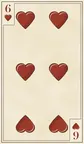
Six of Hearts meaning in cartomancy
6♥︎ · 6 of Hearts · Hearts · shared history · reconciliation · emotional stability · responsibility
How it is read
Reading this card as an old lover coming back is too narrow: in cartomancy, it is read as shared history, emotional familiarity, and the work of reconciliation. Readers take it as a prompt to examine what remains active from the past, whether that is a childhood friendship, a family disagreement, or a habit learned in an earlier relationship. A call to someone you miss fits this reading, but so does finally having a conversation that keeps being postponed. The useful distinction is between drawing comfort from an old connection and repeating it simply because you know your part.
Traditions differ over the emphasis: some readers center nostalgia and emotional repair, while others also read it as a significant male loved one or a masculine perspective. In that person-centered tradition, a brother, close friend, or sweetheart may be the relevant subject rather than a memory. The question and surrounding cards help readers choose between a person, an established bond, and unfinished emotional business. Across these readings, the practical question is what deserves care now: a relationship worth repairing, an obligation worth discussing, or a familiar arrangement that needs to change.
Reading this card for a question of your own? New customers get 5 minutes with a live reader for $1 →
In love
In a relationship spread, the card is read as familiar affection, shared memories, and an interest in keeping the peace. For an established couple, readers may connect it with ordinary acts of care: remembering a difficult anniversary, making time for dinner, or reopening a disagreement without keeping score. When the question concerns an ex, the emphasis falls on the bond's history and what reconciliation would require, rather than treating reunion as the default reading. In a question about feelings, readers take it as tenderness or protective concern, while asking whether the comfort of familiarity leaves enough room for an honest conversation.
Money and work
For money and work questions, readers can apply the card's themes of responsibility and established relationships to the people involved in a decision. A job offer from a former colleague, a friend's advice about a bill, or a family business arrangement gives that reading a concrete setting. Readers who draw on cardology also associate this card with duty, negotiation, and supporting others, examining whether financial responsibilities are shared fairly. The practical focus is the agreement behind the goodwill: who pays which expense, what work each person takes on, and whether loyalty makes it difficult to discuss compensation.
Yes or no?
Yes · by the color rule (red for yes, black for no): yes
For a direct yes/no question, readers generally take this card as yes, especially when the question concerns reconnecting, accepting support, or discussing a repair to an existing relationship. That reading agrees with the simple color rule in which red cards answer yes. Its emotional context puts the emphasis on willingness to engage, including the conversation or practical effort the question involves.
Prefer to ask with tarot? Pull a yes or no card here.
As a birth card
People with this birth card may seem simply easygoing, but readers describe active peacemakers whose preference for stability can become resistance to change. Their strong side is a willingness to find common ground, give generously, and forgive rather than keep a grievance alive. In everyday life, that can look like helping a divided group agree on an outing or staying patient while everyone has their say. The stumbling point is treating an established routine as worth preserving even when nobody enjoys it anymore, simply because changing it feels disruptive. Cardology accounts differ in emphasis: some present contentment with what is available as the central strength, while others give equal weight to the boredom and rigidity that can accompany it.
Birthdays with this card
- October 29
- November 27
- December 25
In cardology the card comes from the month and day alone: 55 − (2 × month + day) gives the solar value, and 6 is the Six of Hearts. What playing card are you? Find yours →
Tarot counterpart
Readers who use both decks pair Hearts with Cups, Clubs with Wands, Diamonds with Pentacles and Spades with Swords, the pairing the French occultist Papus already gave. Ace to Ten keep their numbers. On that pairing the Six of Hearts sits where the Six of Cups does. The two decks are read in separate traditions, so the meanings overlap in places and part ways in others.
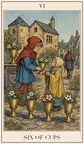 The tarot counterpart: Six of Cups →Hearts pair with Cups. Its upright and reversed meaning, love and yes or no.
Questions
Is the Six of Hearts read as someone from the past?
Often, yes: readers connect it with a person or situation carrying emotional history. That could be a school friend, a former partner, or a family custom still shaping a current decision. In a spread position about the present, the useful question is how that history affects today's choices.
Why is the Six of Hearts sometimes read as a man?
Some cartomancy readers give this card a gendered association alongside its connection with the past. Within that tradition, it is read as a cherished male person or a masculine point of view. Other readers emphasize memory and harmony instead, so the person-based reading belongs to a particular approach.
How do you read the Six of Hearts with other cards?
Start with the question and the card's position in the spread, then use neighboring cards to refine the subject. In a position about an obstacle, familiar routines may deserve scrutiny; in a position about advice, readers might emphasize a thoughtful conversation with someone trusted. Keep the interpretation tied to the actual situation.