☰ Cards, readings & spreads
Three of Diamonds meaning in cartomancy
3♦︎ · 3 of Diamonds · Diamonds · small payments · practical skills · uneven effort · uncertain values
How it is read
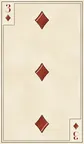
Three diamond-shaped pips appear on the card, with no court figure or illustrated scene to supply a story. In cartomancy, the card is read as small sums of money, practical effort, and the question of whether an arrangement can sustain itself. Readers connect the Diamonds suit with material concerns, so everyday examples include payment for a repair, a temporary assignment, or a shared expense that needs discussing. The emphasis falls on the relationship between effort and return: how much work goes into something, what comes back, and whether those terms are worth accepting.
Traditions disagree about how favorable that exchange is: some readers take it as earned progress through skill and cooperation, while others read it as restricted growth, inconsistent effort, or less money than expected. A modest fee for a well-finished job fits the first reading; repeated revisions for the same fee fit the second. The question and the surrounding spread help the reader distinguish a useful small beginning from a pattern of doing too much for too little. A practical question to ask is whether this arrangement is developing steadily or simply requiring the same effort again.
Reading this card for a question of your own? New customers get 5 minutes with a live reader for $1 →
In love
In a relationship spread, the card is read as tentative interest, uneven commitment, or an arrangement that receives attention only intermittently. Some readers emphasize casual curiosity and appreciation of a person's skills, while others focus on the partner who makes plans warmly and then leaves messages unanswered. A conversation about sharing bills that keeps being postponed gives the practical side of this reading a concrete setting: affection and dependable participation are separate questions. Readers use the surrounding spread to explore whether the connection is still finding its footing or whether one person repeatedly carries the work of keeping it going.
Money and work
For money and work, the card is read as a small payment, a developing skill, or progress that takes close attention to costs. Readers who favor its constructive side take it as cooperation and earned recognition, such as completing a paid trial assignment or contributing specialist knowledge to a group project. The more restrictive tradition stresses an undersized fee, a short-term contract, or a job whose extra hours swallow the value of the pay. In either approach, useful questions concern the actual terms: what the assignment pays, who handles revisions, and whether the experience justifies the effort.
Yes or no?
Yes · by the color rule (red for yes, black for no): yes
For a direct question, readers using the earned-progress interpretation take this as a qualified yes, especially for a modest purchase, paid task, or collaborative project. That agrees with the simple color rule, under which red cards answer yes and black cards answer no. Readers using the restrictive interpretation are more hesitant, particularly when the question concerns lasting commitment or a substantial return.
Prefer to ask with tarot? Pull a yes or no card here.
As a birth card
The suit’s focus on material security combines with the rank’s creativity and variety: readers describe a resourceful learner who can struggle to settle on priorities. Some birth card interpretations emphasize indecision and worry; others put the adaptable apprentice, always learning, at the center. When a hobby project goes wrong, this person may spot the flaw, learn an unfamiliar technique, and try again rather than abandon it. That appetite for possibilities can also leave them switching between interests, unsure which deserves sustained attention. Readers take it as a useful prompt to distinguish genuine curiosity from the habit of reopening a choice whenever another option appears.
Birthdays with this card
- January 24
- February 22
- March 20
- April 18
- May 16
- June 14
- July 12
- August 10
- September 8
- October 6
- November 4
- December 2
In cardology the card comes from the month and day alone: 55 − (2 × month + day) gives the solar value, and 29 is the Three of Diamonds. What playing card are you? Find yours →
Tarot counterpart
Readers who use both decks pair Hearts with Cups, Clubs with Wands, Diamonds with Pentacles and Spades with Swords, the pairing the French occultist Papus already gave. Ace to Ten keep their numbers. On that pairing the Three of Diamonds sits where the Three of Pentacles does. The two decks are read in separate traditions, so the meanings overlap in places and part ways in others.
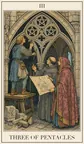 The tarot counterpart: Three of Pentacles →Diamonds pair with Pentacles. Its upright and reversed meaning, love and yes or no.
Questions
Why do readers disagree about the Three of Diamonds?
Different cartomancy traditions give different weight to modest gains and restricted growth. Some readers take it as worthwhile progress achieved through cooperation; others emphasize how little remains after the effort involved. Choosing a consistent reading method keeps the interpretation from changing merely to suit a preferred answer.
Is the Three of Diamonds read as cheating in love?
Some readers include a side relationship among its possible readings, using neighboring cards to develop that interpretation. More broadly, it is read as divided attention or inconsistent involvement. A reader can begin with concrete patterns such as canceled plans, irregular contact, or avoided discussions rather than jumping immediately to an affair.
How is the Three of Diamonds read beside a court card?
In the restrictive tradition, readers take this pairing as a description of someone changeable or unreliable in their participation. At work, that could frame a discussion about a colleague who agrees to help but contributes only sporadically. The court card's position helps establish whose role the reader is examining.