☰ Cards, readings & spreads
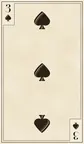
Three of Spades meaning in cartomancy
3♠︎ · 3 of Spades · Spades · separation · misunderstanding · interference · painful clarity · indecision
How it is read
Reading this card as an automatic accusation of cheating narrows it too far: in cartomancy, it is read as separation, misunderstanding, or a painful division that needs attention. Readers often connect it with an unwelcome third element, such as a friend's advice crowding out a couple's own conversation or another commitment taking time away from an agreement. The emphasis falls on what has become difficult to say, share, or keep together. A conversation repeatedly postponed, conflicting accounts of an argument, or an arrangement maintained out of habit all fit this reading.
Traditions differ in emphasis: some readers foreground loss and deception, while others give more weight to confusion, withdrawal, or a problem growing through neglect. In a spread, the question and surrounding cards help distinguish an actual parting from the strain of people talking past each other. For a planned move, for example, readers might focus on disagreement about leaving rather than the practical business of packing. The useful question is where the division sits: between two people, between competing obligations, or between what someone says they want and what they keep agreeing to do.
Reading this card for a question of your own? New customers get 5 minutes with a live reader for $1 →
In love
In a relationship reading, the card is read as hurt, distance, or a disagreement that has become harder to discuss honestly. Some cartomancy traditions emphasize unfaithfulness and parting; others read the same pattern more broadly as interference, including a relative's criticism, a friend's advice, or work repeatedly displacing time together. When the question concerns someone's feelings, readers take it as emotional guardedness or unresolved pain, especially around a conversation both people keep postponing. The practical focus is the point of disconnection: what was said, what was assumed, and what each person needs to ask directly rather than have explained by somebody else.
Money and work
In a question about money or work, the card is read as crossed messages, strained cooperation, or a problem left unresolved until it affects the wider arrangement. Everyday examples include a disputed bill, coworkers giving conflicting instructions, or a partnership in which neither person has clearly agreed who pays which expenses. Readers who emphasize division might focus on a disagreement over responsibilities, while those who emphasize confusion would look more closely at unclear terms in a job offer. The useful questions concern specifics: which amount is disputed, whose approval is missing, and which conversation about pay or workload keeps being put off.
Yes or no?
No · by the color rule (red for yes, black for no): no
For a direct yes/no question, readers take it as a no, drawing on its associations with division, misunderstanding, and strained agreements. That agrees with the simple color rule: red answers yes and black answers no. In a question about accepting an offer, the emphasis is on the unresolved terms. Read the no alongside the disagreement or missing conversation identified in the spread.
Prefer to ask with tarot? Pull a yes or no card here.
As a birth card
Creative experimentation competes with the need for a steady direction in the personality readers describe for this birth card. Some cardology accounts foreground artistic expression, while others emphasize testing ways to improve personal habits and well-being. Readers take it as resourcefulness and a willingness to try another method when an approach falls short, but also restlessness that can turn choice into prolonged indecision. Someone might find inventive uses for leftover craft materials, then leave the project unfinished because another design seems more interesting. The difficulty is distinguishing a useful experiment from another restart: revising a daily routine can help them learn what fits, while continually replacing it leaves little chance to find out.
Birthdays with this card
- January 11
- February 9
- March 7
- April 5
- May 3
- June 1
In cardology the card comes from the month and day alone: 55 − (2 × month + day) gives the solar value, and 42 is the Three of Spades. What playing card are you? Find yours →
Tarot counterpart
Readers who use both decks pair Hearts with Cups, Clubs with Wands, Diamonds with Pentacles and Spades with Swords, the pairing the French occultist Papus already gave. Ace to Ten keep their numbers. On that pairing the Three of Spades sits where the Three of Swords does. The two decks are read in separate traditions, so the meanings overlap in places and part ways in others.
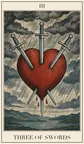 The tarot counterpart: Three of Swords →Spades pair with Swords. Its upright and reversed meaning, love and yes or no.
Questions
Is the Three of Spades read as cheating?
Some cartomancy traditions read the Three of Spades as unfaithfulness, especially when the question concerns a divided relationship. Other readers emphasize misunderstanding or outside involvement more generally. A useful distinction is whether the spread concerns broken trust, competing demands, or somebody else's opinions taking over a private discussion.
How do you read the Three of Spades with other cards?
Readers use the spread position and neighboring cards to locate the tension. In a position concerning the difficulty, it is read as a split or misunderstanding; in a position concerning what to address, readers focus on the neglected conversation. Keep the interpretation tied to the original question rather than importing a relationship story into every reading.
Why is the Three of Spades associated with a third person?
Some readers interpret the rank as introducing another element into an existing arrangement, then read that element through the suit's associations with difficulty. That produces the familiar theme of interference. The extra element can be a person, but readers also apply it to an obligation or commitment that complicates an agreement.