☰ Cards, readings & spreads
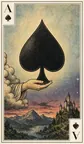
Ace of Spades meaning in cartomancy
A♠︎ · Spades · endings · hard decisions · clarity · transformation
How it is read
In cartomancy, this card is read as a decisive ending, a difficult truth, or a change that requires leaving an old arrangement behind. Readers often connect it with the point at which a postponed conversation, an unresolved dispute, or an unsustainable commitment needs a clear decision rather than another temporary fix. Some traditions emphasize trouble and loss, while others emphasize transformation and the opening created by a clean break. The useful distinction is between recognizing that something has run its course and assuming that whatever replaces it must be better.
In a spread, readers take it as a reason to examine what needs to stop, what needs to be said plainly, and what remains within your control. Beside Hearts, the emphasis may fall on an emotional boundary or a relationship conversation; beside Diamonds, it may fall on the practical cost of a decision. A cluster of Spades can give the reading a heavier emphasis on pressure, conflict, or difficult choices. Read in a position about advice, it invites a concrete question: which unfinished matter would benefit from a direct answer today?
Reading this card for a question of your own? New customers get 5 minutes with a live reader for $1 →
In love
In a relationship reading, the Ace of Spades is read as a hard conversation, a firm boundary, or the ending of a pattern that both people keep repeating. Readers might connect it with arguments followed by silence, uncertainty about exclusivity, or a separation that has been discussed but never addressed practically. In a position about feelings, some readers emphasize intensity, while others emphasize strain or the need for clarity; the surrounding cards help establish which reading fits. The practical question is what needs to be spoken about directly, whether that is commitment, living arrangements, or the conversation that keeps getting postponed.
Money and work
For money and work, the Ace of Spades is read as a difficult decision, a cutoff, or a change in how a problem is handled. Readers may apply it to leaving an unsustainable role, declining a job offer with unacceptable conditions, or finally dealing with a bill that has been pushed aside. In an advice position, the emphasis falls on separating the facts from the hope that an awkward arrangement can carry on unchanged. Nearby Diamonds can focus the reading on costs and payment terms, while other Spades may bring workload or conflict into focus. A useful question is which obligation needs a clear limit before another commitment is considered.
Yes or no?
No · by the color rule (red for yes, black for no): no
For a direct yes/no question, the Ace of Spades is read as no when its emphasis is on stopping, closing a matter, or refusing an unsuitable arrangement. That agrees with the site's color rule: black cards answer no. Traditions differ, and some readers treat every Ace as affirmative; choose the rule before drawing rather than switching methods to obtain a preferred answer.
Prefer to ask with tarot? Pull a yes or no card here.
As a birth card
The restless self-improver in a family or workplace is a role cardology readers associate with the Ace of Spades. This birth card is read as ambition coupled with searching self-examination: readers describe someone willing to tackle ingrained habits rather than accept them as fixed. Interpretations vary, with some emphasizing worldly achievement versus spiritual purpose, others personal reinvention, and others insecurity and a need for recognition. That determination might show in rebuilding a neglected exercise routine or questioning whether a much-praised accomplishment actually feels worthwhile. The difficulty comes when improvement becomes a verdict on personal worth, so that a missed workout feels like failure or praise matters more than the reasons for pursuing the goal.
Birthdays with this card
- January 13
- February 11
- March 9
- April 7
- May 5
- June 3
- July 1
In cardology the card comes from the month and day alone: 55 − (2 × month + day) gives the solar value, and 40 is the Ace of Spades. What playing card are you? Find yours →
Where the death-card label comes from
The death-card label has several historical associations rather than a single securely documented origin. In England, the elaborate Ace of Spades served as proof that playing-card duty had been paid, and a card maker was hanged for forging official aces. That episode is sometimes suggested as a connection with death, while the ornate design itself grew out of taxation and efforts to discourage forgery.
A more direct association comes from its use by American troops during the Vietnam War. Soldiers left the card on bodies and scattered it during raids, intending it as an intimidating symbol. The supposed Vietnamese superstition behind this tactic was an American misconception, with the practice instead supporting American troop morale. These uses belong to the card's cultural history; in contemporary cartomancy, many readers interpret its death imagery as closure or transformation.
Tarot counterpart
Readers who use both decks pair Hearts with Cups, Clubs with Wands, Diamonds with Pentacles and Spades with Swords, the pairing the French occultist Papus already gave. Ace to Ten keep their numbers. On that pairing the Ace of Spades sits where the Ace of Swords does. The two decks are read in separate traditions, so the meanings overlap in places and part ways in others.
 The tarot counterpart: Ace of Swords →Spades pair with Swords. Its upright and reversed meaning, love and yes or no.
Questions
Does the Ace of Spades represent death in cartomancy?
Many contemporary readers interpret the death association symbolically, as the ending of a role, habit, or arrangement. A move out of a shared home or the closure of a business partnership gives that reading a practical setting. Traditions vary in how strongly they emphasize loss versus renewal.
How is the Ace of Spades read with Hearts?
Readers often connect this pairing with the emotional side of a difficult choice. In a relationship spread, it might frame a discussion about boundaries; in a family question, it might focus on the feelings attached to a move. The positions matter: advice and feelings call for different applications of the same combination.
Why is the Ace of Spades more decorated than other aces?
Its distinctive decoration comes from English playing-card taxation. Official aces used increasingly elaborate designs to make forgery harder, and manufacturers retained the ornate treatment after the tax arrangements changed. On many modern packs, that space carries the maker's identifying design or information.