☰ Cards, readings & spreads
King of Diamonds meaning in cartomancy
K♦︎ · Diamonds · practical authority · financial judgment · expertise · material security
How it is read
Compared with the King of Hearts, the emphasis here is on practical authority: who manages the resources, sets the terms, and takes responsibility for a decision. In cartomancy, the King of Diamonds is read as financial judgment, professional standing, and the ability to turn experience into workable arrangements. Readers often take it as an established businessperson, an adviser, or the person whose approval matters when a contract or purchase is being discussed. As a court card, it can describe someone involved in the question or the approach the reader is examining: negotiate carefully, know the costs, and make responsibility explicit.
Traditions differ over the figure behind that authority: many emphasize commerce and wealth, while others read this king as a scholar or specialist whose influence comes from knowledge. In a work spread, that distinction could separate the manager approving a budget from the expert checking whether the proposal is sound. The harder reading concerns possessiveness, greed, or an insistence that only one person's judgment counts. A useful question is whether the person holding the purse strings is making a sound decision or simply making every decision.
Reading this card for a question of your own? New customers get 5 minutes with a live reader for $1 →
In love
In a relationship reading, the King of Diamonds is read as commitment expressed through practical care: paying a shared bill, organizing a move, or making room for a partner's work. Readers take it as someone who values reliability and established plans, sometimes more comfortably discussing a mortgage than a difficult feeling. The same pattern can become controlling when financial support comes with conditions, or when one partner treats earning more as permission to decide everything. For an existing relationship or a new connection, the useful question is whether practical security supports an honest conversation or substitutes for the conversation that keeps being postponed.
Money and work
For money and work, the King of Diamonds is read as experienced financial management, business authority, and a clear sense of what a skill or service is worth. Readers may take it as the employer discussing a job offer, the adviser reviewing a loan, or your own role in setting a price and defending it. Some traditions emphasize specialist knowledge rather than ownership, so a question about promotion may turn on expertise as much as management status. In a difficult spread, readers examine the less attractive side of that authority: an unreasonable contract, a boss who withholds information, or a purchase driven more by status than usefulness.
Yes or no?
Yes · by the color rule (red for yes, black for no): yes
Readers generally take the King of Diamonds as yes, particularly when the question concerns practical competence, clear terms, or taking responsibility. That reading agrees with the simple color rule: red cards answer yes, and Diamonds is red. For a question about accepting a job offer, the emphasis is on pay, duties, and decision-making authority rather than enthusiasm alone.
Prefer to ask with tarot? Pull a yes or no card here.
As a birth card
Focused expertise and firm convictions are strengths readers describe here; the difficulty comes when confidence hardens into certainty that others are wrong. For the King of Diamonds birth card, some cardology accounts emphasize devotion to a specialized skill, while others stress leadership and a strong sense of values. They also disagree about confidence: some describe stubborn self-assurance, while another emphasizes indecision and mistrust beneath a cool exterior. This might be the friend who patiently learns how to repair a bicycle, then dismisses a different method without trying it. When teaching a beginner, the same command of detail can make instructions clear—or make every correction feel like a challenge to the teacher's competence.
Birthdays with this card
- January 14
- February 12
- March 10
- April 8
- May 6
- June 4
- July 2
In cardology the card comes from the month and day alone: 55 − (2 × month + day) gives the solar value, and 39 is the King of Diamonds. What playing card are you? Find yours →
Tarot counterpart
Readers who use both decks pair Hearts with Cups, Clubs with Wands, Diamonds with Pentacles and Spades with Swords, the pairing the French occultist Papus already gave. Kings and Queens stay Kings and Queens. On that pairing the King of Diamonds sits where the King of Pentacles does. The two decks are read in separate traditions, so the meanings overlap in places and part ways in others.
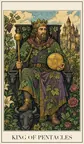 The tarot counterpart: King of Pentacles →Diamonds pair with Pentacles. Its upright and reversed meaning, love and yes or no.
Questions
Why is the King of Diamonds called the Man with the Axe?
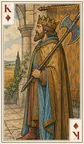
The nickname comes from the axe shown with this king in the familiar playing-card design described by cartomancy readers. Those readers sometimes connect the object with firm decisions and a willingness to hold a position. That interpretation belongs to the reading tradition; the literal starting point is the weapon in the illustration.
Why is the King of Diamonds called the one-eyed king?
The king is shown in profile in the familiar design, leaving only one eye visible. Some readers use that detail as an image of concentration, while others connect it with a narrow point of view. In a spread about a disagreement, that gives the reader a concrete question: whose perspective is missing from the discussion?
Does the King of Diamonds represent a man or a woman?
Readers can take this king as a person of any gender occupying a position of expertise or practical authority. The royal title supplies a role rather than a requirement about who fills it. Depending on the question, the relevant person might be a business owner, a knowledgeable colleague, or the partner managing household finances.