☰ Cards, readings & spreads
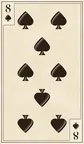
Eight of Spades meaning in cartomancy
8♠︎ · 8 of Spades · Spades · restriction · disappointment · imbalance · reassessment
How it is read
The Four of Spades is often read as rest or confinement; the Eight shifts the emphasis toward the restriction itself and the strain of dealing with it. In playing-card cartomancy, the card is read as disappointment, physical limitation, or an arrangement that asks more than it gives back. Readers might connect it with a move held up by unfinished paperwork, an exhausting obligation, or a conversation repeatedly postponed because neither person wants to face it. The practical question is where the difficulty sits: in circumstances, in someone's behavior, or in an assumption that has gone untested.
Traditions differ: some readers emphasize illness and frustrated plans, while others emphasize examination, research, and reassessing what is no longer working. These readings share an interest in the point where ordinary progress becomes difficult enough to require closer attention. In a spread about an unresolved problem, readers may take it as reviewing a rejected application, checking a recurring expense, or asking why an agreement remains one-sided. Read alongside the question and neighboring cards, it gives the reader a way to distinguish a firm limit from something that needs investigation.
Reading this card for a question of your own? New customers get 5 minutes with a live reader for $1 →
In love
In a relationship reading, the card is read as uneven effort, hurt feelings, or affection that is not being returned in the same measure. Readers might connect it with one person always arranging visits, an unanswered request for commitment, or a disagreement that keeps getting buried instead of discussed. In an established partnership, the emphasis can shift toward the pressure of illness, work, or obligations that leave little room for each other. A useful question is whether both people recognize the strain and are participating in the conversation, rather than leaving one person to carry it.
Money and work
In questions about money and work, the card is read as restriction, disappointment, or the need to examine a problem before committing more resources. A job offer with demanding hours, a bill that squeezes the household budget, or duties that keep expanding without extra pay all fit this reading. Readers who emphasize investigation may take it as checking contract terms, reviewing expenses, or looking closely at why an application was rejected. The focus is on identifying the actual constraint: insufficient money, an unreasonable workload, or an arrangement whose costs have been easy to overlook.
Yes or no?
No · by the color rule (red for yes, black for no): no
For a direct yes/no question, readers take it as no because its usual reading centers on restriction, imbalance, and frustrated plans. That agrees with the simple color rule in which red answers yes and black answers no. For a question such as whether to accept an offer as written, the emphasis falls on the terms that make agreement difficult.
Prefer to ask with tarot? Pull a yes or no card here.
As a birth card
Steady willpower and a capacity for hard work can turn into relentless self-pressure when achievement becomes a measure of personal worth. Cardology readers describe this birth card through discipline, persistence, and the responsibility attached to being capable. Interpretations diverge: some emphasize productive effort and the desire for admiration, while others put inner examination and adaptation ahead of outward accomplishment. The pattern might show in someone patiently mastering a difficult repair, then refusing to stop when tired because leaving it unfinished feels like failure. Readers take it as a reason to ask whether persistence still serves the task, or whether changing approach would require more honesty than simply pushing harder.
Birthdays with this card
- January 6
- February 4
- March 2
In cardology the card comes from the month and day alone: 55 − (2 × month + day) gives the solar value, and 47 is the Eight of Spades. What playing card are you? Find yours →
Tarot counterpart
Readers who use both decks pair Hearts with Cups, Clubs with Wands, Diamonds with Pentacles and Spades with Swords, the pairing the French occultist Papus already gave. Ace to Ten keep their numbers. On that pairing the Eight of Spades sits where the Eight of Swords does. The two decks are read in separate traditions, so the meanings overlap in places and part ways in others.
 The tarot counterpart: Eight of Swords →Spades pair with Swords. Its upright and reversed meaning, love and yes or no.
Questions
Is the Eight of Spades read as illness?
Illness and physical restriction belong to several traditional readings of this card. Readers also connect it with a medical examination, discomfort, or the practical limits surrounding recovery. In a health-related spread, the emphasis may fall on how symptoms affect daily routines and what questions someone wants to raise at an appointment.
How is the Eight of Spades different from the Seven of Spades?
Readers commonly take the Seven as a mishap, an unexpected setback, or plans abruptly going off course. The Eight is more often read as the restriction or imbalance that needs sustained attention. A sudden cancellation fits the Seven's emphasis; repeatedly struggling with an arrangement that accommodates only one person fits the Eight's.
Why do Eight of Spades interpretations differ?
Playing-card readers use different sets of associations, and cardology adds a separate framework for reading personal patterns. A cartomancy reading may emphasize disappointment or examination, while a cardology reading emphasizes discipline and power through work. Keeping the chosen system clear makes the interpretation more consistent than blending every association into one answer.