☰ Cards, readings & spreads
Five of Clubs meaning in cartomancy
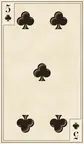
5♣︎ · 5 of Clubs · Clubs · action · change · restlessness · competition · practical effort
How it is read
Reading every difficult exchange as a fight is a common misreading here: in cartomancy, the Five of Clubs is read as action, change, and effort, with competition as one possible expression. Readers take it as the work of getting something moving, whether that involves preparing for a job interview, rearranging a workshop, or finally making a postponed phone call. The Art of Cartomancy connects the card with the fingers of a hand, an association behind its readings of making, repairing, physical labor, and exercise. That gives the interpretation a practical starting point: what needs doing, and where is effort actually going?
The restless side becomes more noticeable when activity lacks a clear purpose, such as starting several applications while finishing none or repeatedly changing the plan for a move. Readers differ in emphasis: some foreground hands-on work and competition, while others stress mental restlessness, communication, and changing interests. In a spread, the question and surrounding cards help distinguish useful adjustment from activity that merely keeps someone occupied. A useful reading asks whether another attempt, a different method, or completing the task already underway best fits the situation.
Reading this card for a question of your own? New customers get 5 minutes with a live reader for $1 →
In love
In a relationship reading, the Five of Clubs is read as effort, restlessness, or the need to change how two people engage with each other. Readers might connect it with repeatedly negotiating time together, competing for attention, or wanting more independence while still taking the relationship seriously. Traditions disagree here: some traditional cartomancy accounts emphasize affection and successful partnership, while restless-minded interpretations put more weight on unsettled expectations. With Hearts nearby, readers may emphasize affection alongside independence; with Spades, they may explore tension or rivalry, asking whether a conversation keeps being postponed because both people are busy or because neither wants to address the disagreement.
Money and work
For work and money, the Five of Clubs is read as practical effort, competition, and changes in how a job gets done. Readers connect it with interviews, physical labor, making something, or putting extra work into a task that has stalled, such as revising a proposal after a client's comments. Its restless expression fits switching between business ideas, chasing several openings without preparing properly for any, or changing a budget before checking the bills. The useful distinction is between adapting a method and abandoning it too quickly: readers take this card as a prompt to examine the application, repair, negotiation, or other concrete task requiring attention.
Yes or no?
No · by the color rule (red for yes, black for no): no
The answer is read as no, which agrees with the red-yes/black-no color rule. From the card's action-and-restlessness reading, readers often qualify that as “not right now”: an application still being revised or a negotiation with unsettled terms. That qualification focuses the reading on unfinished work rather than treating delay as an eventual yes.
Prefer to ask with tarot? Pull a yes or no card here.
As a birth card
Curiosity pulls toward fresh ideas while dissatisfaction pushes familiar answers aside, a tension readers describe as both an appetite for learning and difficulty feeling settled. In cardology, this birth card is read as mentally adaptable, sociable, and quick to explore an unfamiliar subject. That strength can show in someone who gets a lively discussion going at a book club or eagerly learns a new hobby, then loses interest once the novelty wears off. Some readers emphasize restless skepticism; others put more weight on experimentation as a way to improve skills and knowledge. The sticking point is treating every unsatisfying moment as a reason to switch direction, rather than staying long enough to put new knowledge to use.
Birthdays with this card
- March 31
- April 29
- May 27
- June 25
- July 23
- August 21
- September 19
- October 17
- November 15
- December 13
In cardology the card comes from the month and day alone: 55 − (2 × month + day) gives the solar value, and 18 is the Five of Clubs. What playing card are you? Find yours →
Tarot counterpart
Readers who use both decks pair Hearts with Cups, Clubs with Wands, Diamonds with Pentacles and Spades with Swords, the pairing the French occultist Papus already gave. Ace to Ten keep their numbers. On that pairing the Five of Clubs sits where the Five of Wands does. The two decks are read in separate traditions, so the meanings overlap in places and part ways in others.
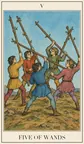 The tarot counterpart: Five of Wands →Clubs pair with Wands. Its upright and reversed meaning, love and yes or no.
Questions
What feelings is the Five of Clubs read as?
Readers take it as active but unsettled interest: wanting contact while also wanting room to act independently. In a feelings position, competition can enter the reading as a need to impress or uncertainty about where someone stands. A concrete example is repeatedly initiating conversation but turning each exchange into a performance.
Is the Five of Clubs read as marriage or relationship trouble?
Both readings appear, but they come from different interpretive approaches. Some traditional relationship readings emphasize being loved and partnership, while some cardology accounts emphasize difficulty settling into a relationship. Keep the system and spread position clear rather than importing a birth-card personality description into every question about a couple.
How is the Five of Clubs different from the Four of Clubs?
In the practical-work approach, the Four of Clubs is read as a stable foundation, while the Five is read as activity or adjustment. Think of an established workbench compared with the repair being carried out on it. Readers use that contrast to distinguish having dependable arrangements from actively changing or using them.