☰ Cards, readings & spreads
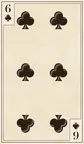
Six of Clubs meaning in cartomancy
6♣︎ · 6 of Clubs · Clubs · practical progress · communication · good counsel · responsibility · steady effort
How it is read
Compared with the Five of Clubs, which readers associate with action and change, the Six of Clubs is read as working through a problem toward resolution. In cartomancy, its common business and social reading centers on practical progress, useful communication, and taking responsibility for unfinished matters. Readers take it as the discussion that gets a stalled project moving, a friend's sensible advice about a move, or the negotiation over who pays an outstanding bill. The emphasis is on putting effort to use: explaining the difficulty, sharing information, and agreeing on something workable rather than simply keeping busy.
Traditions differ, however, and that difference matters when choosing a reading method. Anglo-American readings emphasize business success, financial help, and profitable cooperation, while the communication-focused approach also includes study, trusted counsel, and exchanging ideas. Italian readings instead emphasize tiredness, toil, and stagnation; the French Sibylle des Salons approach gives it a sharper association with hostility and disputes. Keep the chosen tradition consistent across the spread, then use the question and surrounding cards to distinguish productive effort from the same unresolved task being passed around again.
Reading this card for a question of your own? New customers get 5 minutes with a live reader for $1 →
In love
In a relationship reading, the Six of Clubs is read as communication, shared responsibility, and the practical work of getting along. Readers take it as a conversation about dividing household chores, making time together around demanding jobs, or finally addressing a discussion that keeps being postponed. In a constructive spread, the focus is on listening and negotiating; within the tiredness-and-toil tradition, the focus shifts to one person doing all the arranging while the other leaves things unresolved. A useful question is whether both people contribute to the relationship, or whether keeping the peace has become another job for one of them.
Money and work
For money and work, the Six of Clubs is read as practical progress, business cooperation, and help with a financial problem in the common Anglo-American approach. Readers might connect it with discussing a payment plan, getting useful advice about a job offer, or clarifying responsibilities with a business partner. The communication reading puts particular weight on negotiations, training, and making sure everyone understands the terms before agreeing. Where the chosen tradition emphasizes fatigue instead, readers take it as a prompt to examine repeated overtime, a project that absorbs resources without moving forward, or duties that need to be shared more fairly.
Yes or no?
Yes · by the color rule (red for yes, black for no): no
In the card-specific approach that emphasizes progress, cooperation, and problem-solving, the Six of Clubs is read as yes. That reading fits questions about opening a discussion, seeking advice, or working toward an agreement. It disagrees with the simple color rule: black cards answer no under that method. Choose the method before drawing, rather than switching rules to get the preferred answer.
Prefer to ask with tarot? Pull a yes or no card here.
As a birth card
The card of intuition is read as a perceptive, peace-seeking personality with a strong sense of responsibility for what gets said. For this birth card, readers emphasize noticing unspoken concerns, seeking order in ideas, and making room for other viewpoints. That can look like noticing someone's hesitation during a group discussion and inviting them to speak before everyone agrees. The difficulty is keeping peace at the expense of candor: softening a correction until the point disappears, or leaving a familiar opinion unexamined. Writers differ on drive, with some emphasizing absorbing, fulfilling work and others mental inertia; the useful tension is between genuine contentment and reluctance to rethink anything.
Birthdays with this card
- March 30
- April 28
- May 26
- June 24
- July 22
- August 20
- September 18
- October 16
- November 14
- December 12
In cardology the card comes from the month and day alone: 55 − (2 × month + day) gives the solar value, and 19 is the Six of Clubs. What playing card are you? Find yours →
Tarot counterpart
Readers who use both decks pair Hearts with Cups, Clubs with Wands, Diamonds with Pentacles and Spades with Swords, the pairing the French occultist Papus already gave. Ace to Ten keep their numbers. On that pairing the Six of Clubs sits where the Six of Wands does. The two decks are read in separate traditions, so the meanings overlap in places and part ways in others.
 The tarot counterpart: Six of Wands →Clubs pair with Wands. Its upright and reversed meaning, love and yes or no.
Questions
Why does the Six of Clubs have different readings?
Readers use different inherited systems rather than one universal dictionary. Business-oriented cartomancy treats this card as cooperation and achievement, while Italian readings emphasize weariness and stalled effort. The useful first step is identifying the method behind an interpretation, especially when comparing websites that present their own approach as standard.
How is the Six of Clubs read as someone's feelings?
Using its communication and responsibility associations, readers take it as concern expressed through practical involvement: making time to talk, helping with a difficult task, or following through on an agreement. In a fatigue-focused reading, attention turns to whether maintaining the connection feels demanding or repetitive.
Is the Six of Clubs associated with hidden enemies?
That association belongs to the French Sibylle des Salons reading cited for this card, alongside disputes and romantic rivalry. It is a different interpretive framework from the familiar business-progress reading. Within that framework, readers examine conflict and competing interests rather than treating every difficult conversation as concealed hostility.