☰ Cards, readings & spreads
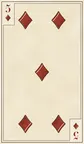
Five of Diamonds meaning in cartomancy
5♦︎ · 5 of Diamonds · Diamonds · financial change · practical adjustments · restlessness · changing values
How it is read
The Five of Spades makes a useful comparison: it answers no under the simple color rule, while this red card answers yes. Beyond that shortcut, in cartomancy the Five of Diamonds is read as change in money, possessions, work, or the practical arrangements that hold daily life together. Readers take it as the unsettled period when an old budget, working agreement, or living arrangement needs another look. A rent increase, a discussion about changing jobs, or the cost of moving gives this reading a concrete setting. The central question is what needs adjusting and what is worth keeping.
Readers differ over how positively to treat that movement: some emphasize constructive change, while others stress financial fluctuation and hesitation about taking risks. Another reading emphasizes reconciliation and practical problem-solving, including help from a friend or family member. In a spread, the question and surrounding cards help distinguish a useful adjustment from restless switching between options. A friend's advice about a bill fits the helpful reading; repeatedly abandoning a workable budget fits the restless one. Read the practical issue first, then ask whether the response to it is solving anything.
Reading this card for a question of your own? New customers get 5 minutes with a live reader for $1 →
In love
In a relationship reading, the Five of Diamonds is read as changing practical needs within the relationship, especially around money, housing, or personal freedom. Readers might connect it with a conversation about shared bills that keeps being postponed, different spending habits, or a proposed move that one partner welcomes and the other resists. When the question concerns feelings, some readers take it as care complicated by distraction or inner conflict, rather than uncomplicated enthusiasm. The reconciliation reading puts attention on what can actually be discussed and renegotiated: who pays for what, how much space each person needs, and which agreement no longer fits.
Money and work
For money and work, the Five of Diamonds is read as financial fluctuation, changing priorities, or a professional adjustment under consideration. A job offer with different hours, an uneven income, a business expense, or a decision about moving for work all fit this practical reading. Some readers emphasize the scope for improvement, especially beside favorable cards; others give more weight to the strain of changing arrangements. The useful distinction is between a considered change and the urge to escape a frustrating week by accepting any alternative. Read it alongside the actual terms: pay, travel costs, bills already due, and the advice available from someone who knows the situation.
Yes or no?
Yes · by the color rule (red for yes, black for no): yes
Read through its constructive-change interpretation, this card is a qualified yes, particularly when the question concerns adjusting a practical arrangement or considering a work opportunity. That agrees with the simple rule that red cards answer yes. Traditions differ: some readers use a soft no when emphasizing financial uncertainty or risk. Here, the yes favors considering a workable adjustment rather than treating every change as an improvement.
Prefer to ask with tarot? Pull a yes or no card here.
As a birth card
Adaptability and social range are strengths readers describe for this birth card, but a need for variety can undermine follow-through. Readers take it as a restless temperament that resists confinement yet wants to accomplish something worth the effort. Accounts disagree about sociability: some emphasize an ability to connect with almost anyone, while others describe someone selective who has little patience for people outside their interests. At a community class, this might look like drawing newcomers into conversation, then losing interest when learning requires repetitive practice. The same appetite for stimulation can support lively discussion, but become demanding perfectionism when others cannot keep pace or an excuse to abandon something before the effort pays off.
Birthdays with this card
- January 22
- February 20
- March 18
- April 16
- May 14
- June 12
- July 10
- August 8
- September 6
- October 4
- November 2
In cardology the card comes from the month and day alone: 55 − (2 × month + day) gives the solar value, and 31 is the Five of Diamonds. What playing card are you? Find yours →
Tarot counterpart
Readers who use both decks pair Hearts with Cups, Clubs with Wands, Diamonds with Pentacles and Spades with Swords, the pairing the French occultist Papus already gave. Ace to Ten keep their numbers. On that pairing the Five of Diamonds sits where the Five of Pentacles does. The two decks are read in separate traditions, so the meanings overlap in places and part ways in others.
 The tarot counterpart: Five of Pentacles →Diamonds pair with Pentacles. Its upright and reversed meaning, love and yes or no.
Questions
Is the Five of Diamonds read as financial loss?
Financial fluctuation is a common reading, but readers also use this card for practical problem-solving and changes in priorities. An unexpected bill and a revised plan for paying it belong to the same territory. The question and surrounding cards determine whether the emphasis falls on the expense, the adjustment, or available help.
How is the Five of Diamonds read as someone's feelings?
Some readers take it as divided attention: affection sits alongside worries about work, expenses, or independence. In that reading, someone struggling to arrange time together may be occupied with practical pressures. A useful follow-up question concerns what is taking up their attention and whether the relationship has room for an honest conversation about it.
What is the difference between the Five of Diamonds in cartomancy and cardology?
In cartomancy, readers interpret the drawn card within a question and spread, often focusing on a changing material situation. In cardology, readers use it as a birth-card pattern associated with freedom, adaptability, and reassessing value. One reading concerns the situation being examined; the other concerns recurring personality tendencies.