☰ Cards, readings & spreads
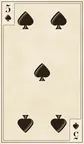
Five of Spades meaning in cartomancy
5♠︎ · 5 of Spades · Spades · conflict · loss · separation · difficult change
How it is read
In cartomancy, the card is read as conflict, loss, or a difficult separation, especially when an arrangement has become hard to maintain. Readers take it as the argument that keeps resurfacing, the friendship strained by resentment, or the decision to stop paying for something that no longer serves its purpose. The emphasis is on the cost of continuing as things stand: money, time, trust, or the effort spent avoiding an uncomfortable conversation. In a spread about an existing problem, it gives the reader a practical question: what needs addressing, reducing, or ending?
Traditions differ: some emphasize anger, grief, and cutting ties, while other readers focus on the action taken to handle a difficulty. That distinction matters when the question concerns a move, a canceled agreement, or a job change, where disruption and practical adjustment can belong to the same situation. Read alongside the question and surrounding cards, separation might concern leaving a group chat, dividing responsibilities, or withdrawing from a disputed purchase. The useful distinction is between a deliberate boundary and a reaction made in anger, rather than treating every appearance as a reason to walk away.
Reading this card for a question of your own? New customers get 5 minutes with a live reader for $1 →
In love
In a relationship reading, the Five of Spades is read as friction, hurt, or distance that needs a direct conversation. Readers take it as the recurring disagreement about money, the unanswered message after an argument, or the habit of postponing a discussion about living together. Where separation is already being discussed, the reading centers on boundaries and the practical terms of taking space; where both people want to stay engaged, it centers on the behavior feeding the dispute. A useful question is whether someone needs room to think, a clearer agreement, or an end to a particular pattern of interaction.
Money and work
For money and work, the Five of Spades is read as a setback, a disagreement, or the difficult adjustment involved in cutting a commitment. Everyday examples include a disputed bill, a project losing funding, or a job offer with conditions that make the pay less attractive. Some readers emphasize loss, while others emphasize the practical work of handling the problem, such as renegotiating a deadline or dropping an expense from the budget. In a career spread, the focus is on identifying the actual source of strain: the workload, the terms of employment, or a conflict with a coworker.
Yes or no?
No · by the color rule (red for yes, black for no): no
For a direct yes/no question, the Five of Spades is read as no, with conflict, loss, or separation weighing against the proposed course. This agrees with the simple color rule many readers use: red answers yes and black answers no. For a question about accepting an offer or renewing an agreement, the useful follow-up is which condition makes the arrangement difficult to sustain.
Prefer to ask with tarot? Pull a yes or no card here.
As a birth card
Restlessness is often the first thing acquaintances notice about someone with this birth card, along with a readiness to try another approach. Cardology readers describe a drive to explore, question familiar routines, and improve through experimentation rather than accept an unsatisfying habit. Sources disagree about how unsettled this looks: some emphasize the wanderer, while others describe a dependable person who can settle and focus when necessary. This might show in suggesting an unfamiliar route on a weekend outing or trying different exercise routines to find a better fit. The difficulty is staying with an approach once its novelty wears off; readers take the restless side as a useful prompt to ask whether another change serves improvement or merely relieves boredom.
Birthdays with this card
- January 9
- February 7
- March 5
- April 3
- May 1
In cardology the card comes from the month and day alone: 55 − (2 × month + day) gives the solar value, and 44 is the Five of Spades. What playing card are you? Find yours →
Tarot counterpart
Readers who use both decks pair Hearts with Cups, Clubs with Wands, Diamonds with Pentacles and Spades with Swords, the pairing the French occultist Papus already gave. Ace to Ten keep their numbers. On that pairing the Five of Spades sits where the Five of Swords does. The two decks are read in separate traditions, so the meanings overlap in places and part ways in others.
 The tarot counterpart: Five of Swords →Spades pair with Swords. Its upright and reversed meaning, love and yes or no.
Questions
Is the Five of Spades always read as a breakup?
Readers distinguish an ending from the strain that prompts people to consider one. Resentment over uneven chores calls for a different interpretation than an explicit discussion of separate homes. The question and the card's position in the spread help the reader choose between everyday friction, a need for distance, and the terms of parting.
Why is the Five of Spades associated with cutting ties?
Some cartomancy sources connect this reading with an older symbolic image of a hand holding a knife. Those readers take cutting as a metaphor for severing a connection or removing a troublesome commitment. In an ordinary playing deck, that association belongs to the interpretive tradition rather than a pictured scene.
Why do Five of Spades interpretations differ between websites?
Many pages discuss cardology personality patterns, while others explain a card drawn for a particular question. In cardology, the emphasis often falls on movement, freedom, and dissatisfaction with routine. In a cartomancy spread, readers more often foreground conflict, loss, or the effort involved in dealing with a problem.