☰ Cards, readings & spreads
Six of Spades meaning in cartomancy
6♠︎ · 6 of Spades · Spades · transition · departure · completion · adjustment · inertia
How it is read
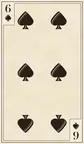
Six black spade pips appear on the face, without a court figure or an illustrated scene to tell you how to read them. In cartomancy, the card is read as departure, transition, or the completion of a difficult phase: packing for a move, finishing a strained work assignment, or stepping away from an arrangement that has become exhausting. Readers take it as a passage between situations, with attention on what is being left behind and what the change requires. A useful question is practical: what needs to be finished, returned, paid, or said before the move can happen?
Traditions disagree about how firmly to close that door: some readers emphasize movement and adjustment, while others emphasize a permanent ending. The distinction matters when someone asks about a separation, a relocation, or a contract approaching its end. In a spread position concerned with obstacles, the same transition theme can focus attention on unfinished arrangements, such as a postponed conversation or an unresolved moving expense. Read it alongside the question and neighboring cards rather than automatically treating every departure as an improvement.
Reading this card for a question of your own? New customers get 5 minutes with a live reader for $1 →
In love
In a relationship reading, the card is read as distance, a change in the relationship's form, or the closing of a chapter. Some readers lean toward separation; others read it as the adjustment involved in leaving an old pattern behind, such as ending the habit of avoiding difficult conversations. A couple discussing separate homes presents a different context from a couple deciding how to stop repeating the same argument. The practical question is what each person is actually moving away from: the relationship itself, an expectation that no longer fits, or a routine neither person wants to continue.
Money and work
In questions about money and work, the card is read as transition or completion: wrapping up a contract, considering a job offer elsewhere, or sorting out the cost of a move. Readers who emphasize endings focus on closing obligations, while those who emphasize movement look at the practical work of changing direction. A final invoice, a handover document, or a bill tied to the old workplace gives that reading something concrete to address. Use the spread to distinguish a clean exit from an unfinished one, then ask which payment, conversation, or piece of paperwork still needs attention.
Yes or no?
No · by the color rule (red for yes, black for no): no
For a direct yes/no question, readers can take the emphasis on departure and closure as a no, especially when asking whether an existing arrangement should continue unchanged. That agrees with the simple color rule: black cards answer no. Some transition-focused readers give a qualified yes instead, so the method matters; this entry follows the no reading.
Prefer to ask with tarot? Pull a yes or no card here.
As a birth card
Spades' focus on the self combines with the rank's association with harmony and fulfillment; readers describe a responsible temperament that can settle too firmly into familiar routines. With this birth card, steadiness shows in keeping a manageable daily routine without constantly searching for something better. Contentment slips into inertia when someone refuses to adjust a habit simply because it is comfortable, or spends more time imagining a project than starting it. Sources disagree about the remedy: some emphasize contentment with existing capacities, while others urge commitment to a larger purpose. Across those readings, the useful distinction is between being satisfied with what works and being too stubborn to reconsider what no longer does.
Birthdays with this card
- January 8
- February 6
- March 4
- April 2
In cardology the card comes from the month and day alone: 55 − (2 × month + day) gives the solar value, and 45 is the Six of Spades. What playing card are you? Find yours →
Tarot counterpart
Readers who use both decks pair Hearts with Cups, Clubs with Wands, Diamonds with Pentacles and Spades with Swords, the pairing the French occultist Papus already gave. Ace to Ten keep their numbers. On that pairing the Six of Spades sits where the Six of Swords does. The two decks are read in separate traditions, so the meanings overlap in places and part ways in others.
 The tarot counterpart: Six of Swords →Spades pair with Swords. Its upright and reversed meaning, love and yes or no.
Questions
Is the Six of Spades read as travel or moving house?
Readers often include literal movement within its departure reading, so travel or relocation can fit a question already concerned with either. For a house move, attention might fall on packing, returning keys, or arranging transport. In a relationship question, the same departure theme may instead concern emotional distance.
Is the Six of Spades always read as a breakup?
A breakup belongs to the ending interpretation, but readers also use this card for a change within an ongoing relationship. The spread position helps separate those readings: a position about what to release could concern an old grievance, while a position about the relationship's current state could emphasize separation.
Why is the Six of Spades associated with both movement and inertia?
These associations come from different reading systems. Cartomancy sources often emphasize departure or completion, whereas cardology sources discuss inertia as part of a recurring personality pattern. Keep the task clear: interpreting a card drawn for a specific question and interpreting a birth card use different frames.