☰ Cards, readings & spreads
Jack of Diamonds meaning in cartomancy
J♦︎ · Diamonds · messenger · practical ambition · ingenuity · apprenticeship · self-interest
How it is read
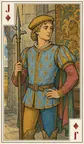
A court figure, the letter J, and red diamond suit signs identify this card in a standard Anglo-American deck. In cartomancy, the Jack of Diamonds is read as a messenger concerned with work, money, and practical opportunities, or as a clever person learning how to turn an idea into something useful. Readers take it as the applicant asking about an opening, the friend forwarding a job listing, or the apprentice eager to demonstrate a new skill. The emphasis is on initiative and communication: who has information, what they are offering, and what needs to be discussed before anyone commits.
Traditions differ over how much trust to place in this figure: some emphasize diligence and perseverance, while others stress charm, restlessness, or self-interest. In a supportive spread, readers take it as resourcefulness and a willingness to learn through experience rather than wait for perfect instructions. In a more difficult context, the same ingenuity is read as a persuasive pitch with thin details, or enthusiasm that fades when routine work begins. A useful question is whether the person discussing an opportunity can explain the terms as clearly as they explain its attractions.
Reading this card for a question of your own? New customers get 5 minutes with a live reader for $1 →
In love
In a relationship reading, the Jack of Diamonds is read as curiosity, lively conversation, and interest expressed through practical contact. Readers take it as someone suggesting a date, discussing a shared move, or finding small reasons to keep a conversation going, with more emphasis on engagement than settled commitment. Within an established relationship, it can frame the difference between enjoying plans together and handling the bills, schedules, and postponed conversations those plans involve. Where the surrounding cards emphasize self-interest or inconsistency, readers look more closely at whether charm is accompanied by attention to the other person's needs.
Money and work
For money and work, the Jack of Diamonds is read as an offer under discussion, useful information, or someone developing a marketable skill. Everyday examples include a recruiter explaining a role, a trainee asking for more responsibility, or a seller presenting a proposal that deserves a careful look at the price and terms. Some readers emphasize steady effort here, while others favor enterprise and quick thinking; both readings put practical ability at the center. In a strained spread, readers take it as a prompt to examine the gap between an appealing pitch and the actual workload, payment arrangement, or level of experience behind it.
Yes or no?
Yes · by the color rule (red for yes, black for no): yes
For a direct yes/no question, readers take the Jack of Diamonds as yes, particularly when the question concerns applying, asking, learning, or opening a practical discussion. Meaning-based readings often qualify that yes with effort and follow-through, rather than treating agreement as effortless success. This agrees with the simple color rule: red cards answer yes, and this card belongs to the red Diamonds suit.
Prefer to ask with tarot? Pull a yes or no card here.
As a birth card
Diamonds' concern with value meets the Jack's youthful experimentation in a cardology portrait of someone inventive, persuasive, and eager to try things firsthand. Readers describe this birth card through playfulness, independence, and the ability to get other people interested in an idea. At home, that might be improvising a gadget from spare parts; among friends, it might be enthusiastically introducing a hobby and making everyone want a turn. The same appetite for experimentation can become dissatisfaction with what is already available, while confidence in an invention can run ahead of testing it. Accounts vary between materially focused and spiritually oriented portraits, sometimes allowing both, but readers take it as a useful question about values: what deserves enthusiasm beyond the pleasure of novelty?
Birthdays with this card
- January 16
- February 14
- March 12
- April 10
- May 8
- June 6
- July 4
- August 2
In cardology the card comes from the month and day alone: 55 − (2 × month + day) gives the solar value, and 37 is the Jack of Diamonds. What playing card are you? Find yours →
Tarot counterpart
Readers who use both decks pair Hearts with Cups, Clubs with Wands, Diamonds with Pentacles and Spades with Swords, the pairing the French occultist Papus already gave. A tarot suit has four court cards (King, Queen, Knight and Page), and the ordinary deck kept three: the Jack is the old Knave, the tarot's Page, and the Knight was dropped. Some readers fold the Knight of Pentacles into the Jack as well. On that pairing the Jack of Diamonds sits where the Page of Pentacles does. The two decks are read in separate traditions, so the meanings overlap in places and part ways in others.
 The tarot counterpart: Page of Pentacles →Diamonds pair with Pentacles. Its upright and reversed meaning, love and yes or no.
Questions
Does the Jack of Diamonds represent a person or a message?
Readers use both interpretations, with the position in the spread helping them choose. In a position about people, it is read as someone clever, enterprising, or still gaining experience. In a position about communication, readers take it as a work-related conversation, an offer, or information about money.
Is the Jack of Diamonds a negative card?
Its reputation varies between traditions. Some readers take it as diligence and practical intelligence; others give more weight to immaturity, salesmanship, or personal advantage. The distinction becomes useful when examining a specific interaction: is someone helping clarify an arrangement, or simply trying to secure agreement?
How is the Jack of Diamonds birth card different from its reading in a spread?
Cardology uses the birth card to discuss a recurring personality pattern, such as experimentation or a desire for independence. In a cartomancy spread, readers interpret the same figure through the question and its position. A discussion about an unpaid invoice calls for a narrower reading than a general portrait of someone's habits.