☰ Cards, readings & spreads
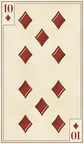
Ten of Diamonds meaning in cartomancy
10♦︎ · 10 of Diamonds · Diamonds · material success · financial security · achievement · shared resources · material responsibility
How it is read
In cartomancy, this card is read as material success, financial security, and the completion of a practical goal. Readers connect the Ten of Diamonds with resources gathered into something substantial: a savings target reached, a business agreement settled, or a household with enough room in its budget to plan beyond the next bill. The emphasis is on tangible results rather than the excitement of starting something new, so a useful question is what has actually been built and what it takes to maintain it. An inheritance, a promotion, or a major purchase can serve as the subject of the reading, depending on the question asked.
Traditions differ over whether to emphasize abundance itself or the sustained responsibility of managing it. In a supportive spread, readers take it as security that gives someone choices; beside difficult cards, the same resources can become a source of pressure, status anxiety, or obligations to others. A well-paid job with demanding hours illustrates that tension better than a simple label of wealth. Read the surrounding cards for who contributes, who benefits, and whether the arrangement leaves enough time for anything beyond maintaining it.
Reading this card for a question of your own? New customers get 5 minutes with a live reader for $1 →
In love
In a relationship reading, the Ten of Diamonds is read as practical commitment, shared security, and the value two people place on building a life together. Readers might apply it to discussing rent before moving in, agreeing on a savings plan, or showing care by taking responsibility for an overdue bill. For a question about feelings, readers take it as regard for someone's reliability and long-term suitability, with affection expressed through dependable actions rather than romantic declarations. In a strained relationship, the useful question is whether the couple genuinely shares priorities or keeps postponing an uncomfortable conversation because their financial lives are already intertwined.
Money and work
For money and work, the Ten of Diamonds is read as substantial achievement, established resources, and the practical results of sustained effort. A reader might connect it with a job offer that improves household finances, a completed contract, or a business whose income now covers both wages and running costs. Context shifts the emphasis from acquiring resources to managing them: a larger salary can sit alongside longer hours, while owning property involves repairs and regular bills. When comparing options, readers use this card to ask what counts as enough, what support the arrangement requires, and whether the apparent gain remains worthwhile after its responsibilities are included.
Yes or no?
Yes · by the color rule (red for yes, black for no): yes
For a direct yes/no question, readers take the Ten of Diamonds as yes, especially when the question concerns practical support, resources, or completing a goal. This agrees with the simple color rule that assigns yes to red cards. Some readers qualify the answer as yes with backing or collaboration, so the surrounding spread helps identify what support the situation calls for.
Prefer to ask with tarot? Pull a yes or no card here.
As a birth card
Confidence in their own abilities is often what acquaintances notice first about someone with this birth card. Cardology readers describe an optimistic, practically minded person who enjoys developing skills, taking responsibility, and having something accomplished to show for the effort. They might volunteer to organize a community event or patiently teach a friend a useful skill, bringing creativity and a conviction that improvement is possible. That confidence can become unrealistic optimism: they take on more than they can handle or treat every unfinished task as a verdict on their worth. Sources disagree about generosity, with some presenting it as characteristic and others stressing self-interest; the useful distinction is whether their abilities serve a shared purpose or mainly their own advancement.
Birthdays with this card
- January 17
- February 15
- March 13
- April 11
- May 9
- June 7
- July 5
- August 3
- September 1
In cardology the card comes from the month and day alone: 55 − (2 × month + day) gives the solar value, and 36 is the Ten of Diamonds. What playing card are you? Find yours →
Tarot counterpart
Readers who use both decks pair Hearts with Cups, Clubs with Wands, Diamonds with Pentacles and Spades with Swords, the pairing the French occultist Papus already gave. Ace to Ten keep their numbers. On that pairing the Ten of Diamonds sits where the Ten of Pentacles does. The two decks are read in separate traditions, so the meanings overlap in places and part ways in others.
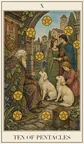 The tarot counterpart: Ten of Pentacles →Diamonds pair with Pentacles. Its upright and reversed meaning, love and yes or no.
Questions
Is the Ten of Diamonds always read as wealth?
Wealth is a common reading, but readers also take it as achievement and responsibility for resources. In a modest household, the subject might be a workable budget or enough savings to replace a broken appliance. The scale comes from the question, rather than from an assumed large sum.
How is the Ten of Diamonds read as someone's feelings?
Readers take it as appreciation of reliability, practical compatibility, and the possibility of building together. In a feelings question, that can frame a discussion about being included in someone's plans. Read neighboring cards for the emotional tone: practical investment can accompany warmth, attraction, or a more transactional attitude.
How do surrounding cards change the Ten of Diamonds reading?
Readers use neighboring cards to qualify the material achievement at the center of this reading. With supportive cards, the emphasis rests on usable resources and cooperation. With difficult cards, attention turns to the cost of maintaining success, such as an exhausting workload or disagreement over who pays for what.