☰ Cards, readings & spreads
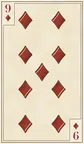
Nine of Diamonds meaning in cartomancy
9♦︎ · 9 of Diamonds · Diamonds · earned success · material independence · progress · completion · letting go
How it is read
The Nine of Hearts is often associated with wishes; by comparison, the Nine of Diamonds is read in cartomancy as the practical progress involved in working toward one. Readers take it as earned success, material independence, and recognition built through sustained effort, with attention on what someone has actually done rather than what they hope to receive. A training course completed alongside a demanding job, a debt reduced through regular payments, or a small business developing repeat customers fits this reading. In a spread, the useful question is what counts as real progress: more income, less dependence on someone else, or finally having room to choose.
Traditions disagree about the emphasis: some cartomancy readers stress advancement, while cardology sources give more space to completion, generosity, and releasing material attachments. These approaches meet around the question of value, but they are distinct interpretations rather than interchangeable definitions. A position concerning an obstacle might invite discussion of chasing a promotion that no longer feels worthwhile, while an advice position might draw attention to finishing an obligation before taking on another. Read the surrounding cards and the position before deciding whether the subject is building something worth keeping or reconsidering what it costs to keep it.
Reading this card for a question of your own? New customers get 5 minutes with a live reader for $1 →
In love
In a relationship reading, the Nine of Diamonds is read as independence, practical contributions, and the place money or status occupies between two people. Readers might explore a couple negotiating separate accounts, one partner paying most of the bills, or a conversation about moving in together that keeps being postponed. The earned-success interpretation puts attention on what each person contributes through consistent action, while the letting-go interpretation asks whether expensive gestures or rigid expectations have become substitutes for closeness. For someone dating, the useful question is whether the connection leaves room for both people’s work, friendships, and financial boundaries, rather than making one person responsible for the other’s sense of worth.
Money and work
For money and work, the Nine of Diamonds is read as earned progress, self-support, and a practical assessment of what an achievement is worth. A reader might connect it with preparing a case for a raise, comparing a job offer with current benefits, or reviewing how much debt has already been repaid. In an advice position, that reading favors looking at records, qualifications, expenses, and completed work rather than treating enthusiasm as the whole case. Where completion and release are emphasized, the discussion shifts toward closing an unprofitable side project, settling an outstanding bill, or deciding that a better title is not worth a longer commute.
Yes or no?
Yes · by the color rule (red for yes, black for no): yes
The Nine of Diamonds is read as yes, especially when the question concerns practical progress, earned recognition, or greater independence. That agrees with the simple color rule in which red cards answer yes and black cards answer no. Read through its meaning, the emphasis falls on the effort, resources, and workable terms behind the choice.
Prefer to ask with tarot? Pull a yes or no card here.
As a birth card
The Giver’s Card is read as an openhearted, generous personality whose strong convictions can harden into fixed judgments. For this birth card, readers emphasize a willingness to share and a habit of forming quick impressions without always being able to explain the reasoning. Sources disagree about how freely that generosity operates: some emphasize easy giving, while others describe a more self-protective character drawn to influential people. At a community group, this might be the person who welcomes a newcomer and shares useful information, yet dismisses another volunteer’s suggestion because of an immediate dislike. The strength is openhanded participation; the difficulty comes when a confident impression leaves little room for someone else’s explanation.
Birthdays with this card
- January 18
- February 16
- March 14
- April 12
- May 10
- June 8
- July 6
- August 4
- September 2
In cardology the card comes from the month and day alone: 55 − (2 × month + day) gives the solar value, and 35 is the Nine of Diamonds. What playing card are you? Find yours →
Tarot counterpart
Readers who use both decks pair Hearts with Cups, Clubs with Wands, Diamonds with Pentacles and Spades with Swords, the pairing the French occultist Papus already gave. Ace to Ten keep their numbers. On that pairing the Nine of Diamonds sits where the Nine of Pentacles does. The two decks are read in separate traditions, so the meanings overlap in places and part ways in others.
 The tarot counterpart: Nine of Pentacles →Diamonds pair with Pentacles. Its upright and reversed meaning, love and yes or no.
Questions
Why is the Nine of Diamonds called the Curse of Scotland?
“The Curse of Scotland” is a historical nickname for this playing card, with competing explanations in its folklore. Readers distinguish that nickname from the interpretation used in a spread. Contemporary cartomancy readings often emphasize achievement and independence instead of carrying the nickname into every question.
Is the Nine of Diamonds read as success or loss?
Readers differ: advancement and material achievement are prominent in some cartomancy interpretations, while release and completion receive more emphasis in cardology. Start with the system being used and the card’s position. An achievement position and a position asking what to relinquish call for different applications.
How do you read the Nine of Diamonds with surrounding cards?
Use the surrounding cards to narrow the subject before choosing an everyday example. If the spread concerns household responsibilities, readers might explore who pays for what; if it concerns work, they might examine recognition or compensation. Keep the interpretation attached to the question rather than adding unrelated financial events.