☰ Cards, readings & spreads
Seven of Diamonds meaning in cartomancy
7♦︎ · 7 of Diamonds · Diamonds · conversation · gossip · patient assessment · financial values
How it is read
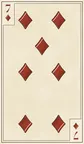
Red diamond pips occupy the face rather than a court figure, leaving the reader to work with suit and rank instead of a pictured scene. In cartomancy, the card is read as conversation, news, or gossip, with the surrounding spread helping readers distinguish useful discussion from irritating talk. The traditions differ: American readings include conversation and gossip, while French readings emphasize mockery and anger, and some contemporary readers favor patience and financial assessment. At the table, these readings fit situations such as a conversation that keeps being postponed, a friend's unsolicited advice, or conflicting accounts of what someone said.
A practical approach is to choose the reading tradition first, then use the question and neighboring cards to narrow the subject. In a question about work, readers might take the conversation reading as a discussion of pay; in a relationship spread, they might focus on comments passed through mutual friends. Readers using the patience interpretation take it as a pause to examine whether continued effort is worthwhile, such as reviewing a project that has absorbed time without a clear return. The useful question is specific: what needs discussing, checking, or reassessing before the next step?
Reading this card for a question of your own? New customers get 5 minutes with a live reader for $1 →
In love
In a relationship reading, the card is read as conversation and the influence of other people's comments on a couple. That can focus attention on a postponed discussion about moving in together, a friend's advice that keeps resurfacing, or an argument conducted through messages rather than face to face. Some contemporary readers take it as romantic interest and affection, while gossip-focused traditions emphasize misunderstandings, teasing, or resentment instead. Let the spread establish which reading fits, then ask something concrete: are both people speaking directly about what they want, or relying on hints and secondhand accounts?
Money and work
For money and work, the card is read as patient assessment by readers who emphasize investment, effort, and material value. Everyday examples include comparing the salary and workload in a job offer, checking whether a side business covers its bills, or reviewing a project before committing more hours. In the conversation tradition, readers take it as the discussion around those matters: a pay negotiation, feedback from a manager, or office gossip about a vacancy. Some readers also associate it with financial gain, but the practical focus remains on the terms under discussion and whether the proposed return justifies the cost.
Yes or no?
Unclear — depends · by the color rule (red for yes, black for no): yes
Read through its themes of discussion and assessment, the answer is maybe: a proposal needs clearer terms, or a conversation remains unfinished. This differs from the simple color rule, under which red cards answer yes and this card therefore gives a yes. Readers using the interpretive approach focus on what needs clarification; readers using color alone keep the affirmative answer.
Prefer to ask with tarot? Pull a yes or no card here.
As a birth card
Clearing abandoned hobby supplies off the table to make room for a serious interest captures the pull between restless reassessment and determined focus. Cardology readers describe this birth card through a concern with what is genuinely worth pursuing, with strengths in concentration, responsibility, and questioning conventional definitions of success. Readers disagree on the central emphasis: some favor spiritual values and letting go of attachment, while others stress ambition and sustained effort toward a clearly defined goal. The difficulty is holding a goal so tightly that achievement becomes the measure of personal worth, or repeatedly changing direction in search of something more satisfying. Choosing which skill to practice can become less about collecting accomplishments and more about deciding what deserves continued attention.
Birthdays with this card
- January 20
- February 18
- March 16
- April 14
- May 12
- June 10
- July 8
- August 6
- September 4
- October 2
In cardology the card comes from the month and day alone: 55 − (2 × month + day) gives the solar value, and 33 is the Seven of Diamonds. What playing card are you? Find yours →
Tarot counterpart
Readers who use both decks pair Hearts with Cups, Clubs with Wands, Diamonds with Pentacles and Spades with Swords, the pairing the French occultist Papus already gave. Ace to Ten keep their numbers. On that pairing the Seven of Diamonds sits where the Seven of Pentacles does. The two decks are read in separate traditions, so the meanings overlap in places and part ways in others.
 The tarot counterpart: Seven of Pentacles →Diamonds pair with Pentacles. Its upright and reversed meaning, love and yes or no.
Questions
Is the Seven of Diamonds read as gossip?
Yes, gossip is an established reading in several cartomancy traditions. American interpretations also include ordinary conversation, while French interpretations lean toward mockery and anger. A useful distinction is whether the spread concerns an exchange between the people involved or comments circulating through someone else.
Why is the Seven of Diamonds associated with patience?
Some contemporary readers emphasize waiting, endurance, and reviewing the results of effort. In that approach, the card is read as taking stock before continuing: checking progress on a delayed assignment, for example. This differs from the conversation-centered tradition rather than replacing it.
How do you read the Seven of Diamonds with other cards?
Start with the question and the card's position in the spread, then read the neighboring cards within the same tradition. In a position concerning an obstacle, conversation might be read as an unresolved disagreement. In an advice position, readers might take it as a prompt to ask for details or review an arrangement.