☰ Cards, readings & spreads
Ten of Spades meaning in cartomancy
10♠︎ · 10 of Spades · Spades · grief · painful endings · worry · setbacks · exhaustion
How it is read
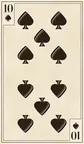
Black spade-shaped pips fill the face of the card; there is no court figure or illustrated scene. In cartomancy, the Ten of Spades is read as grief, a painful ending, or pressure that has become difficult to carry through an ordinary day. Readers take it as the disappointment surrounding a canceled move, the strain of an unresolved dispute, or the exhaustion of repeatedly trying to rescue a failing arrangement. The emphasis falls on both the difficulty itself and the worry it creates: checking for a reply, replaying an argument, or putting off opening a bill.
Traditions disagree about where this sits in a sequence: older readings emphasize sorrow and disadvantage, while some modern readers frame it as the aftermath of a crisis. That difference matters, because an ending under discussion and an ending already being processed call for different questions. In a spread, the position and neighboring cards help readers distinguish a practical setback from fear, suspicion, or grief surrounding it. A useful question is what has become unsustainable, and whether the next conversation concerns repairing the arrangement, accepting its limits, or bringing it to a close.
Reading this card for a question of your own? New customers get 5 minutes with a live reader for $1 →
In love
In a relationship reading, the Ten of Spades is read as hurt, emotional exhaustion, or an ending that is difficult to acknowledge. Readers take it as the strain of a conversation that keeps being postponed, an argument that returns without resolution, or the grief of staying attached after contact has stopped. Some traditions include secrecy and betrayal among its associations; in that reading, the focus belongs on the specific breach of trust being discussed, rather than an invented story about a partner. Context shifts the emphasis between separation, disappointment within an ongoing relationship, and the question of how much longer someone wants to maintain the same painful pattern.
Money and work
For money and work, the Ten of Spades is read as a costly setback, an unfavorable arrangement, or the exhaustion attached to keeping a project going. Everyday examples include a bill that absorbs the emergency fund, a job offer with unacceptable conditions, or a contract whose demands outweigh its pay. In a spread about a decision, readers take it as a reason to examine the expense, workload, and consequences of continuing, especially when embarrassment makes it hard to admit that an arrangement is failing. Some cardology sources emphasize work achievement instead, but ordinary cartomancy readings more often concentrate on the burden or disadvantage surrounding the question.
Yes or no?
No · by the color rule (red for yes, black for no): no
For a direct yes/no question, the Ten of Spades is read as no: its associations with disadvantage, strain, and painful endings weigh against proceeding on the present terms. That agrees with the simple color rule in which black cards answer no. The useful follow-up is which condition makes the proposal unacceptable, such as the price, workload, or unresolved conflict.
Prefer to ask with tarot? Pull a yes or no card here.
As a birth card
Finishing a demanding practice session and immediately planning the next captures a drive for improvement that leaves little room to pause. Cardology readers describe this birth card through sustained effort, mental and physical resilience, and a persistent need to become more capable. Sources disagree over the central emphasis: some stress accomplishment and workaholism, while others focus on inward development through both strength and vulnerability. The strength is a willingness to keep practicing a difficult passage of music or patiently rebuild a neglected skill; the trap is treating every spare hour as another assignment. Rest can become something to justify, and sensitivity something to overcome, even though the inward-looking interpretation makes room for both.
Birthdays with this card
- January 4
- February 2
In cardology the card comes from the month and day alone: 55 − (2 × month + day) gives the solar value, and 49 is the Ten of Spades. What playing card are you? Find yours →
Tarot counterpart
Readers who use both decks pair Hearts with Cups, Clubs with Wands, Diamonds with Pentacles and Spades with Swords, the pairing the French occultist Papus already gave. Ace to Ten keep their numbers. On that pairing the Ten of Spades sits where the Ten of Swords does. The two decks are read in separate traditions, so the meanings overlap in places and part ways in others.
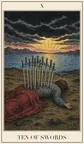 The tarot counterpart: Ten of Swords →Spades pair with Swords. Its upright and reversed meaning, love and yes or no.
Questions
Why is the Ten of Spades considered a bad card?
Its reputation comes from cartomancy traditions that associate it with sorrow, loss, regret, and severe restriction. Readers take it as one of the deck's harder descriptions of a situation. In practice, that can concern the emotional weight of a rejected application or a friendship that has become exhausting.
Is the Ten of Spades read as the worst being over?
That is one modern interpretation, rather than a shared rule across cartomancy traditions. Some readers emphasize surviving a difficult experience; others focus on distress that still needs attention. A closed business with outstanding bills illustrates the distinction: the closure is settled, while its practical and emotional costs remain part of the reading.
How do you read the Ten of Spades with other playing cards?
Start with the question and the role assigned to each position in the spread. As an obstacle, it is read as strain, fear, or a difficult ending that complicates the matter; as advice, readers may ask what needs closing out. Neighboring cards then give that pressure a more specific setting, such as a relationship or a work commitment.